





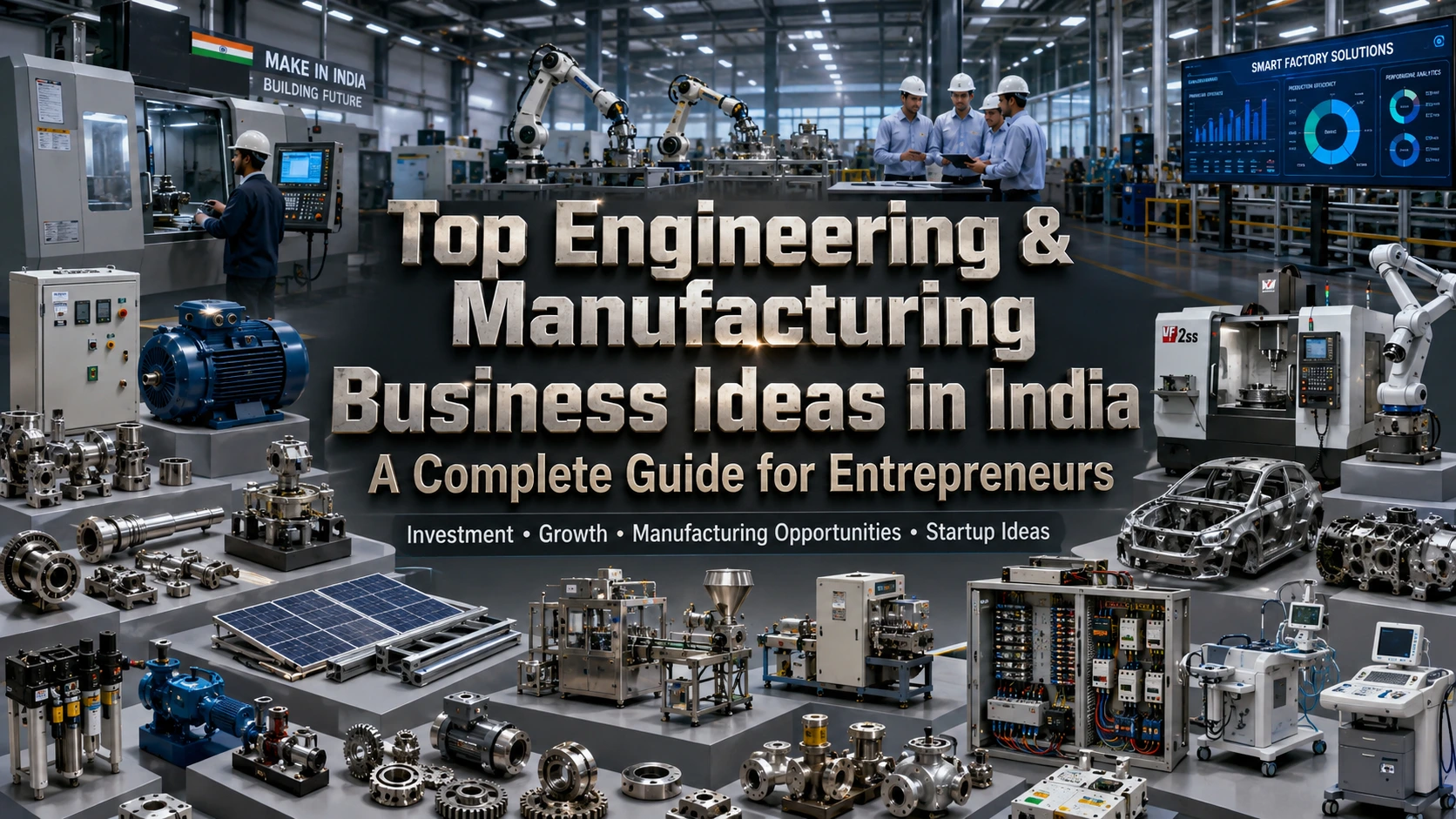
Engineering Manufacturing Business Ideas in India
Today, India’s manufacturing sector is as vibrant as ever with promising business ideas. The country has successfully re-oriented itself as a viable alternative to China-led supply chains. The Make in India initiative, Production Linked Incentives (PLI) and the PM Gati Shakti National Master Plan are all initiatives that are actively encouraging this transformation. With a massive domestic market, a rising middle class and unprecedented investments in infrastructure, current manufacturers can no longer afford to ignore this demand.
Two forces are coming together in this moment and they make it that much more compelling. On another side, the demand is rising sharply, including in infrastructure, housing, EVs, defence and exports. On the other, there are never been more supply-side enablers, including improvements in policy, logistics, technology, and a developing industrial base. The engineering and manufacturing sector in India is a unique opportunity for entrepreneurs who are willing to invest in capital and attention. It is an excellent sector for any entrepreneur willing to invest in the capital and focus, as it has a perfect mix of scale, sustainability, and commercial returns.
This guide focuses on nineteen product categories, ranging from corrugated tanks and copper wire drawing, to CNC components, composite LPG cylinders and aluminium recycling. They are each an entire business system, have their own demand curve, capital structure, and growth curve.
India’s Manufacturing Moment: Why Enter Now
Three structural shifts are transforming Indian manufacturing and creating long-term opportunities. Three structural shifts are transforming Indian manufacturing and creating enduring opportunity.
First, the amount of expenditure on infrastructure is unprecedented. Steel pipes and conveyor systems, aluminium extrusions and fabricated items are being used in vast quantities in urban water supply, highways, railways, smart cities, and housing. Second, the EV transition is getting underway. This involves the use of three to four times more copper per car for EVs as compared to conventional engines, creating strong demand for wire rods, wiring harnesses and lightweight aluminium forgings. Thirdly, Aatmanirbhar Bharat’s indigenisation initiative is creating new markets for India to gain access to precision CNC components and special fabrications, which were previously being imported.
Further, the diversification of the global value chains is directly helping Indian manufacturers. With regard to sourcing from China, western buyers are actively weakening their reliance on China. Thus for entrepreneurs who can prove themselves to be consistent in quality and consistent in delivery, this opens direct access to high-end export markets.
Discover business ideas that actually make money
High-Growth Business Ideas in Engineering and Manufacturing
The nineteen product categories in this section are quite various in terms of capital needed and the technical expertise required. One thing they have in common, though, is that they each have structural demand exceeding current domestic supply, which is increasing at a faster rate.
Low-to-Mid CapEx Opportunities (₹40 Lakh – ₹5 Crore)
These segments are entry points where there is no big capital commitment. They are ideal for first generation entrepreneurs and MSMEs who are seeking manageable risk and high return on investment.
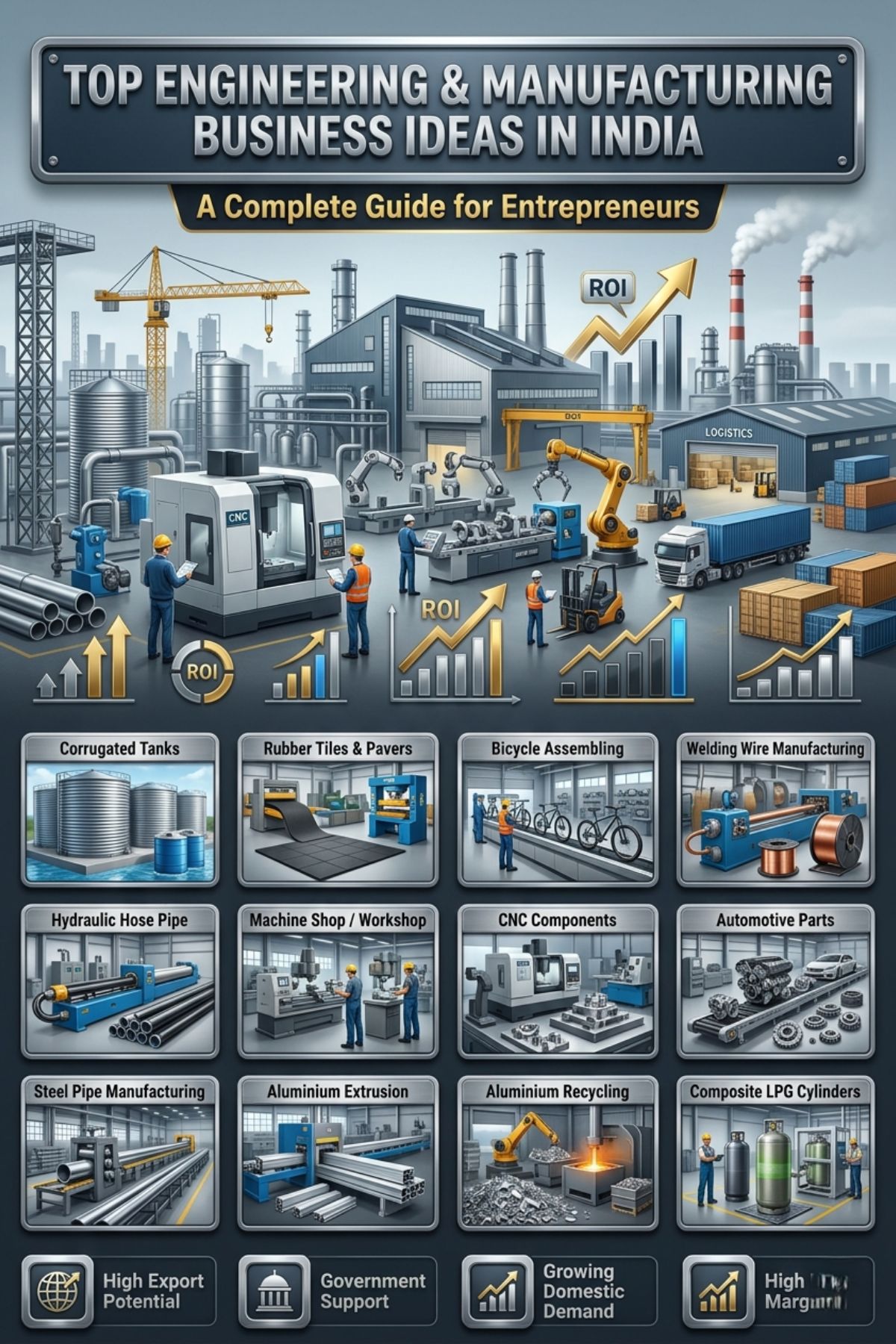
Corrugated Tanks (Market: ₹2,800 Cr+; CAGR: 9-11%) are made using galvanised steel sheets and used in agriculture and rural water storage, fire safety and construction site applications. The capital investment for a medium scale unit is in the range of ₹60–90 lakh, with gross margins ranging from 18–25 percent. The demand is increasing by leaps and bounds due to Jal Jeevan Mission and the growing rural housing schemes.
Rubber Tiles and Pavers market size is valued at ₹1,200 cr and expected to grow at 11-13% CAGR during the forecast period, with production being made using recycled tyre rubber. This segment will be a sustainable and economic segment. The cost of investment ranges between ₹40/70 lakh; the raw material is easily available and the EBITDA margin is in the range of 22-30 per cent. Demand is rising due to the school infrastructure improvement, Smart City projects and the fitness centre boom.
Bicycle Assembling (Market: ₹6,500 Cr+, CAGR: 8 – 10%) has completely changed. India is an important market for bikes as the country produces more than 20 million bikes each year, with increasing variety of electric, performance and cargo bikes. The assembly model is designed to keep capital requirements down whilst maintaining healthy margins. But, more importantly than manufacturing capability is the brand strategy and market access that enables this success.
Welding Wire (Market: ₹4,200 Cr+, CAGR: 8–10%) is used in all metal fabrication industries, be it in the construction domain, shipyards, railroads or vehicle manufacturing. The cost of setting up a MIG/MAG wire unit is ₹1- 2.5 crore. The main difference is in quality consistency—entrepreneurs who take the time and investment to ensure proper spectroscopic analysis and feed-testing facilities reap the rewards of a high-quality reputation that can be rewarded with higher prices.
Get Detailed Project Report (DPR): MIG Welding Wire Manufacturing Plant Report
Hydraulic Hose Pipe (Market: ₹3,500 Cr+, CAGR: 9-12%) is used in construction equipment, tractors, mining machinery, and industrial hydraulic systems. The complete production line comes with a price tag of ₹1.5–3 crore. More importantly, the service life of hydraulic hoses is limited to 2–5 years, which essentially generates a market for this replacement on a recurrent basis, a market that new players can access via a network of workshops.
Machine Shop / Workshop (Market: ₹15,000 Cr+ and CAGR: 10-12%) is one of the most solid manufacturing business models in existence. A general machine shop can be used for various industries starting from ₹50 lakh–₹1.5 crore. This built-in diversification safeguards income. Moreover, the machine shops are often transformed into specialised manufacturing companies — many of the successful precision component manufacturers in India started out as a general machine shop that identified a niche in its customer network.
Mid-to-High CapEx Opportunities (₹5 Crore – ₹40 Crore+)
These segments have higher upfront investment requirements but the potential for larger size of business, better competitive moats and better margins over the long term.
CNC Components (Market: ₹25,000 Cr+ CAGR: 14-16%) is the segment that is growing the fastest in this guide. Aerospace, defence, automotive transmissions, medical devices and industrial equipment are all categories of products precision machined. Tight-tolerance CNC shops with good business models typically operate in the 18 to 28 percent range with their EBITDA. On this foundation, P. Ravinder Reddy established MTAR Technologies, Hyderabad and created a world-class precision business that supplies ISRO, DRDO and aerospace majors around the world.
Automotive Parts (Market: ₹5,60,000 Cr+, CAGR: 10–12%) is the sector’s largest opportunity by absolute size. India exports automotive components worth billions annually to the US, Germany, Japan, and the UK. (Source: ACMA) The EV transition is reshaping the parts landscape — battery management systems, power electronics housings, and lightweight structural parts are the next high-growth sub-categories. Vivek Chaand Sehgal’s Motherson Group illustrates what patient, customer-focused manufacturing can achieve: from a modest Delhi wiring harness operation to a global tier-1 automotive supplier.
Steel Pipe Manufacturing (Market: ₹38,000 Cr+, CAGR: 9-11%) is used in the water supply, oil and gas, construction, and process industries. The setup cost for a small ERW plant is in the range of ₹3-6 crore with an EBITDA in the range of 8-14 percent. B.K. Goenka’s Welspun Corp shows how good manufacturing and quality certification can open up the world, by trading from textiles to being one of the world’s largest pipe suppliers to the US oil and gas industry.
Read the Complete Book Here: Handbook on Steel Bars, Wires, Tubes, Pipes, S.S. Sheets Production with Ferrous Metal Casting & Processing
Aluminium Extrusion (Market: ₹12,000 Cr+, CAGR: 11–13%) produces profiles used in construction, solar mounting systems, automotive parts, and electronics. Construction accounts for approximately 40 percent of demand. A 3,000-tonne-per-year plant requires ₹10–18 crore. Value-added extrusion with anodising or powder coating commands significantly better margins than plain profiles.
Aluminium Recycling consumes just 5% of the energy required to produce primary aluminium, making it one of the most energy-efficient and environmentally-friendly manufacturing prospects on the planet. The material spread in a medium scale operation is of ₹3-8 crore and it is spread between the scrap input and finished secondary aluminium, which spread is 25-40 percent. The market is being driven toward secondary aluminium by both the formalization of the GST and demands for corporate sustainability. The market is moving towards secondary aluminium production as a result of the GST formalisation and demands for corporate sustainability.
Composite LPG Cylinders (Market: ₹1,800 Cr+, CAGR: 18–22%) are the fastest-growing product in this entire guide. These next-generation cylinders are 50–65 percent lighter than steel equivalents, translucent, corrosion-proof, and longer-lasting. A mid-scale plant requires ₹25–40 crore, but the growth trajectory and margin profile make this an investment-grade opportunity for patient capital.
Related Article: LPG Alternatives in India: Profitable Business Ideas for Entrepreneurs
Government Support and Schemes for Manufacturers
The policy regime is pro-manufacturing in India. The credit guarantee, technology upgradation support and cluster development are the core areas of interest in the Ministry of MSME. The Udyam Registration portal streamlines the process of formalising MSMEs, facilitating access to Priority Sector Lending.
Important schemes and supports include:
- Collateral-free credit facility for micro and small enterprise, up to ₹5 crore — CGTMSE
- Capital subsidy for technology upgradation of small manufacturing units (CLCSS)
- Production-linked financial incentives for the automotive, chemical, and other segments (PLI Schemes)
- State Government Incentives — Capital subsidies, Electricity tariff concessions, Industrial land at preferential rates, etc.
- For regulated products such as LPG valves, steel pipes and composite cylinders, BIS Certification is mandatory.
Besides, PESO is responsible for the safety of LPG and explosive-related products. MSMEs can get marketing support and technological services from National Small Industries Corporation (NSIC). The allocation of industrial land is under the control of State Industrial Development Corporations (SIDCs) on subsidized rates.
How NPCS Supports Manufacturing Entrepreneurs
Information on the technical feasibility and the commercial viability differences is one of the most frequent problems faced by first generation manufacturers. Niir Project Consultancy Services (NPCS) directly tackles this issue with Market Survey cum Detailed Techno-Economic Feasibility Reports on the manufacturing processes, raw material sourcing, plant layout, equipment requirements and complete financial projections (capital costs, operating costs, break-even analysis, return on investment, etc.).
NPCs reports are also used by many entrepreneurs to approach banks or investors. The credibility that lenders demand to check the eligibility of a loan is provided by the techno-economic analysis. A well-prepared feasibility study always returns many times its value by helping to make the right decisions and avoid errors in any new manufacturing facility that is being considered by any entrepreneur.
Frequently Asked Questions
Q1. What is the average investment needed to start manufacturing business in India?
This can differ widely depending on product and size. The start-up cost of simple assembly operation or machine shop is ₹30–75 lakh. Manufacturing such as aluminium extrusion or composite LPG cylinders is so time consuming that it may cost between ₹25-50 crore. The best way to do this is to start from a realistic capacity and work upwards from equipment quotations.
Q2. What are the most significant certifications?
For all the products regulated such as steel pipes, LPG valves and few electrical products, BIS certification (ISI mark) is required. Automotive units and export units are obligatory to be ISO 9001. For OEM automotive supply, IATF 16949 must be followed. AS9100 is used in the field of aerospace and defence. Composite LPG Cylinders are to be approved by PESO as well as BIS.
Q3. What should be the criteria for picking a product as a first-generation businessman?
Where you know, start. Select a product that you have experience in the market or products that have customers that you have relationships with. A product in a non-fashionable but very familiar category will almost always beat a fashion product in which you have little domain knowledge and don’t have any relationships.
Q4. Which are the best segments to export?
CNC components, automotive parts, aluminium forgings, bicycle assembly and welding wire are all good exports. India is known as a country which is cost competitive in precision engineering. At the same time, buyers in the West are actively looking for alternative sources to China, which is offering direct opportunity for Indian manufacturers to prove their consistency, quality and reliability.
Q5. How long would you estimate from the start of the project to commercial production?
With simpler operations such as rubber tile units or machine shops, production can be achieved in 6–9 months. A typical timeframe for more complex plants involving process certification (composite cylinders, LPG valves) or capital-intensive lines (aluminium extrusion) is 18-30 months from project sanction to stable commercial plant output.
Conclusion: Building for the Long Arc
It’s not a cyclical upswing in India’s demand for manufactured goods. It consists of a structural multi-decadal trend resulting from population growth, income growth, investment in infrastructure, and deepening of industries. There are nineteen product categories in this guide, all of which represent viable, real market opportunities — and all of which exemplify the tremendous variety of opportunity available to serious business people today.
A typical manufacturing entry barrier is not the cost of capital. It is a combination of capital resources, domain knowledge, customer relationship and operational discipline to ensure quality at cost pressure. Businesses built by entrepreneurs who work patiently and realistically in manufacturing and with a sincere desire for quality will stand the test of time. The moment to begin is now — not tomorrow, or today, or some future date when things are better.


