





Medical Glove Manufacturing Business in India
Medical gloves is one of the biggest volume disposable medical products sold worldwide, and India’s production of surgical and examination gloves has traditionally relied heavily on Malaysia and Thailand; now India is moving towards a serious production of medical gloves which offers a paradigm shifting opportunity for entrepreneurs investing in dipping technology and quality certification. The surgical glove business in India is worth more than Rs 2,500 crore and is expanding at 12 per cent per year and the time is ripe for new players.
Market Opportunity: Why This Business Cannot Be Ignored
During COVID-19 pandemic, India’s reliance on imported gloves became urgent as the country was importing about 65 per cent of medical gloves from Malaysia, which cut exports. The Ministry of Textiles has been created the PLI Scheme for Medical Textiles with an outlay of Rs 1,480 crore with the express objective of tackling this vulnerability by promoting the production of gloves and medical textiles in the country. This policy opportunity provides an incentive to entrepreneurs to invest in dipping technology and quality certification.
The geographical spread of the domestic manufacturing base is limited and the major markets are in Kerala and Tamil Nadu with a big gap in the northern and western part of the country. All medical gloves sold in India must have BIS certification for IS:4544 (latex surgical gloves) or IS:15972 (nitrile examination gloves) which provides a barrier of quality and prevents the entry of low quality medical gloves in the market and also gives an incentive to the investment that is made in quality systems by providing premium institutional pricing to the certified medical glove manufacturers.
Get Detailed Project Report (DPR): Complete Medical Rubber Manufacturing
Industry Analysis: Growth Drivers and Demand Outlook
The total surgical and examination glove market in India is worth more than Rs 2,500 crore and increasing at a compound annual growth rate of 12-15 per cent. The key structural factors driving the increased demand for gloves in India are the expansion of the hospital infrastructure, in the country, and the crores of hospital beds being added every year under PMJAY, which requires dozens of pairs of gloves per bed per month in ICU and OT rooms. The surgical and examination glove standards are set by WHO guidelines around surgical glove use in healthcare that guide institutional procurement in all hospital systems around the world and meet BIS specification requirements in India.
Nitrile gloves are now preferred worldwide and almost all the nitrile gloves required in India are imported. The government of India has introduced the concept of Make in India for medical devices to encourage domestic manufacturing of nitrile gloves, and provided support for CE marking in EU markets. By setting up a nitrile dipping line, an entrepreneur can immediately compete in the import substitution market in various buyer categories and also avail the production incentives under the PLI scheme. The Invest India Medical Devices import substitution brief is a list of top-priority medical devices where PLI scheme support and duty benefits are more in favor of the domestic manufacturers over importers.
India Medical Glove Market Overview
| Category | Market Detail | Notes |
| Surgical Gloves (sterile, latex/nitrile) | Rs 1,200 crore+ | Hospital OT and procedure use |
| Examination Gloves (non-sterile) | Rs 1,300 crore+ | Hospitals, labs, diagnostics |
| Market Growth Rate (CAGR) | 12-15% per year | Post-COVID sustained growth |
| Import Share | 80%+ from Malaysia and Thailand | AIMED estimates |
| BIS Certification Required | IS:4544 (latex), IS:15972 (nitrile) | Mandatory for India market |
| CDSCO Classification | Class B Medical Device | MDR 2017 India |
| Key Domestic Manufacturers | Kanam Latex, Comfort Gloves, Safefit | Listed Indian brands |
How to Start: Step-by-Step Guide for Entrepreneurs
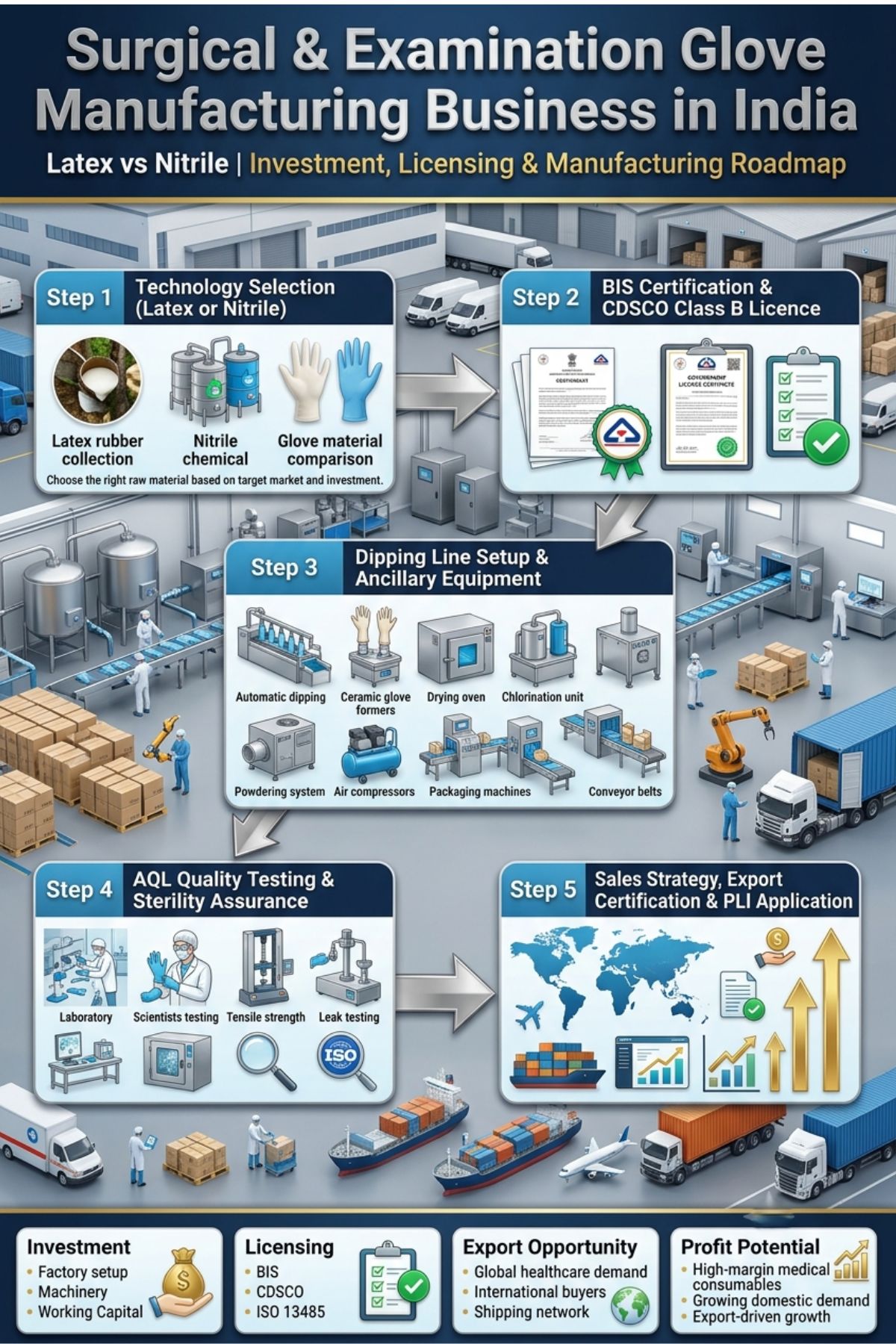
Step 1: Technology Selection: Latex or Nitrile
Natural rubber latex gloves are manufactured by compounded latex dipping method and are generally more competitive in areas of rubber plantation in either Kerala or Tamil Nadu. Nitrile gloves are made with synthetic acrylonitrile butadiene polymer dipping lines, allowing for their establishment at any location in India. The initial equipment cost for nitrile is higher (Rs 3-8 crore for a basic line) but there is a faster growing nitrile market in the world and better export pricing for it. The new glove manufacturing units can register on the Udyam MSME Registration Portal to avail benefits under PLI Medical Textiles scheme, PMEGP Capital subsidy scheme, Collateral-free Loans under CGTMSE scheme and benefit from the incentives provided to textile sector by the state government.
Read the Complete Book Here: Handbook on Medicinal Herbs with Uses
Step 2: BIS Certification and CDSCO Class B Licence
Examination and surgical gloves are class B Medical Devices under MDR 2017 that require a Manufacturing Licence from the State Licensing Authority. In India surgical latex gloves (IS:4544) and examination surgical nitrile gloves (IS:15972) are required to be sold certified by BIS. Export and government hospital tender participation requires ISO 13485 quality management certification, which is strongly recommended.
Step 3: Dipping Line Setup and Ancillary Equipment
Glove dipping line is composed of ceramic or aluminum formers on conveyor, dipping tanks for coagulant and glove compound, hot air vulcanization ovums, powder or powder-free tumbling stations, automatic inspection and counting line. Requires extra investment in validated autoclave sterilisations and double sterile packaging for sterile surgical gloves.
Step 4: AQL Quality Testing and Sterility Assurance
The medical gloves are tested according to BIS and EN 455 standards on critical defects (holes through water leak test), dimensional compliance, tensile strength, elongation at break and force at break based on AQL (Acceptable Quality Limit) of 1.0-1.5. Sterile surgical gloves must have a validated sterility assurance level (SAL) of 10-6. Set up an in-house testing lab, including water leak bench, dimensional gauges, and tensile tester.
Step 5: Sales Strategy, Export Certification, and PLI Application
Bid the tenders for the government hospitals in GeM and bid premium for private hospital chains and institutional distributors. If your glove unit is eligible for PLI Medical Textiles benefits, apply to the Ministry of Textiles. CE mark for export (EN 455 (EU) / US FDA 510(k) for US market access). Apply for export documentation and RoDTEP duty refund benefits with FIEO and DGFT. The Ministry of Textiles has introduced PLI Medical Textiles scheme for surgical and examination gloves manufacturers for capital investment in both latex and nitrile dipping technology. Indian glove manufacturers are supported with the market intelligence, buyer databases and participation support at Arab Health Dubai and Africa Health exhibitions through the Pharmaceuticals Export Promotion Council (Pharmexcil).
Related Article: Startup Business Opportunities in Nitrile Gloves Manufacturing
Investment Estimate for Nitrile Examination Glove Plant
| Cost Item | Estimated Amount (INR) | Notes |
| Dipping line (former conveyor, tanks, oven) | Rs 120 – 200 lakhs | Core production system |
| Factory building construction (10,000 sq ft) | Rs 50 – 80 lakhs | Including boiler room and QC lab |
| Powder-free tumbling and stripping station | Rs 15 – 25 lakhs | Post-dipping finishing |
| Inspection and counting machine | Rs 10 – 18 lakhs | AQL inspection line |
| QC laboratory (tensile, water leak, dimensions) | Rs 6 – 10 lakhs | Mandatory testing lab |
| Nitrile compound raw material (1 month) | Rs 20 – 35 lakhs | Imported nitrile latex compound |
| BIS IS:15972 certification and CDSCO licence | Rs 4 – 7 lakhs | Regulatory costs |
| Working capital (3 months) | Rs 20 – 35 lakhs | Salaries, utilities, packaging |
| TOTAL PROJECT COST | Rs 2.45 – 4.10 crore | Medium plant: 5 million pairs per month |
Financial Projections and Profitability
The medium size nitrile glove plant with production capacity of 5 million pair/month can produce Rs 12-18 crore in a year at a blended institutional price. The CII (Confederation of Indian Industry) Health Committee stated the net margins of 16-22 percent can be achieved in the certified medical glove manufacturing after the cost of raw material, energy and labour with payback in 3.5-5 years.
PLI scheme provides an additional financial advantage to the manufacturers who are eligible. High quality premiums can be realized in the markets of the Gulf, Africa and Europe of 20 to 30 percent over domestic prices. FIEO (Federation of Indian Export Organisations) helps medical glove exporters get connected directly with buyers at the international trade fairs like Arab Health Dubai and Medica Dusseldorf. Medical glove manufacturers who export their products to duty refundable countries can avail duty refund benefit from DGFT export incentive portal which will add to their price competitiveness in the market of hospital supplies in the Gulf countries, Africa countries and European countries when compared with the manufacturers in Malaysia and Thailand.
Turn your budget into a successful business plan
Government Schemes and Incentives for Medical Manufacturers
| Government Scheme | Key Benefit | Eligible Unit Type |
| PMEGP (KVIC/MSME) | 25-35% capital subsidy, max Rs 25 lakh | New manufacturing startups |
| CGTMSE (SIDBI) | Collateral-free loans up to Rs 5 crore | MSME glove manufacturers |
| PLI – Medical Textiles | Production incentive for gloves and medical nonwoven | Eligible textile manufacturers |
| PLI – Medical Devices | 4-6% production incentive on incremental sales | Approved device manufacturers |
| State MSME Capital Subsidy | 15-25% on plant and machinery | State-notified MSME units |
| Export: FIEO and RoDTEP | Export credit and duty refund on exported goods | Registered exporters |
Entrepreneur Spotlight
Asha Devi Sharma | Ahmedabad, Gujarat
In the initial year of 2020, when India faced a problem of stocking gloves during the crisis, Asha Devi Sharma spotted the need and started a nitrile examination glove unit with a term loan of Rs 2.8 crore loan from SIDBI and Gujarat state capital subsidy at Gujarat Institute of Development in Vatva, Ahmedabad. Within 14 months of project start, she installed a 4-former nitrile dipping line, and started production.
Asha got BIS IS:15972 certified and is manufacturing 3.5 million examination gloves per month for hospital chains, diagnostic labs and food processing companies in Gujarat and Rajasthan. She is striving for CE marking for export to the European Union and is working with a distributor from the Netherlands, whom she met at a medical device trade fair organised by FIEO.
How NPCS Supports Your Business Launch
Niir Project Consultancy Services (NPCS) have completed more than 8,000 Detailed Project Reports (DPRs) in various industrial areas such as medical devices and hospital disposables and many more, over a period of more than 45 years. The NPCS DPR includes plant layout, specification of machines (with contacts of suppliers), sourcing of raw materials, CDSCO licensing pathway, financial projections and bank ready investment analysis for manufacturing of surgical and examination gloves (latex and nitrile dipping).
Business owners who hire a NPCS DPRs are provided with information on government scheme applications, export registrations, and quality certification roadmaps tailored to their state and size. You can find project reports for this sector at niir.org or Entrepreneur India at entrepreneurindia.co that include sector case studies and investment analysis in Entrepreneur India magazine.
Key Reference Links and Further Reading
Bureau of Indian Standards – IS:4544 and IS:15972 (Gloves): https://www.bis.gov.in
FIEO – Federation of Indian Export Organisations: https://www.fieo.org
Make in India – Medical Devices Sector: https://www.makeinindia.com/sector/medical-devices
CII – Confederation of Indian Industry (Health Committee): https://www.cii.in
Frequently Asked Questions
Q: Latex and nitrile gloves are produced in similar ways, but there are some differences.
A: Latex gloves are made with natural rubber compound, have good elasticity and sensitivity, but may cause allergic reactions in people who are sensitive. Nitrile gloves are synthetic polymer made from acrylonitrile butadiene and are free of latex, have chemical resistance and are more durable. Nitrile dipping lines are more expensive than rubber dipping lines, but have a larger market and are growing rapidly in the world and are exported at better prices.
Q: AQL testing is a method that can assess the quality of gloves; why is it important for glove manufacturers?
A: AQL (Acceptable Quality Limit) testing is used to calculate the number of gloves that can be defective in a production lot. According to EN 455 and BIS standard, the medical gloves need to have the AQL rating between 1.0 to 1.5 for the critical defects like hole and tears. Water-leak testing, dimension testing and tensile testing should be performed on every production batch before the product is released for production, and QC records are to be kept for regulatory inspection.
Q: No, BIS certification is not required for medical gloves to be sold in India.
A: Yes. Under the Bureau of Indian Standards (Compulsory Registration) Order, surgical gloves made of latex as per IS:4544 and examination gloves made from nitrile as per IS:15972 are compulsory to get BIS certified. Medical gloves must be certified by BIS before they are allowed to be placed in the clinical or institutional supply chain, such as hospital procurement and distribution to medicine departments.
Q: Can I make gloves for export without domestic BIS Certification?
A: If manufacturing is only for export, the certifications required for the target market are required: CE marking (EN 455 standard) for Europe, US FDA 510(k) for the United States and ISO 13485 for general international market access. The manufacturing can be done without BIS certification when all the production is exported, but most of the manufacturers are operating both domestic and export markets for catching diversified revenue.
Q: Where do I get the nitrile latex compound for manufacturing gloves?
A: The primary manufacture of Nitrile latex compound is in Japan, Taiwan, China and Malaysia and has to be imported by the manufacturers in India. Major suppliers include such as Malaysia’s specialty polymer producers, Zeon Corporation (Japan) and LG Chem (South Korea). Domestic specialty chemical distributors offer ancillary chemicals such as calcium nitrate coagulant, release agents and vulcanising accelerators.
Q: How can NPCS help me set up a glove manufacturing plant?
A: NPCS prepares Detailed Project Reports for Latex Gloves and Nitrile Gloves that include specifications of dipping line, equipment’s vendor recommendations, sterile and non-sterile line factory layouts, BIS and CDSCO licensing roadmap, raw material sourcing guide, and financial projections for different scales. For project reports on medical glove manufacturing visit niir.org.
Conclusion
The surgical/examination glove manufacturing industry is one of the most compelling options for import substitution investment in India’s medical device market, bolstered by the Government of India’s PLI Medical Textiles scheme and by AIMED’s data and documentation of India’s import dependency (80 percent) of gloves, which is a clear policy and commercial imperative to do more in the country.
An entrepreneur that invests in the right dipping technology, BIS certification, and quality systems creates a sustainable, scalable enterprise that has multiple revenue streams. Get a Detailed Project Report from NPCS that meets all the mandatory regulatory requirements for glove manufacturing from BIS as per IS:4544 and IS:15972 to begin your business with a strong regulatory base.


