





Ornamental Fish Export Business
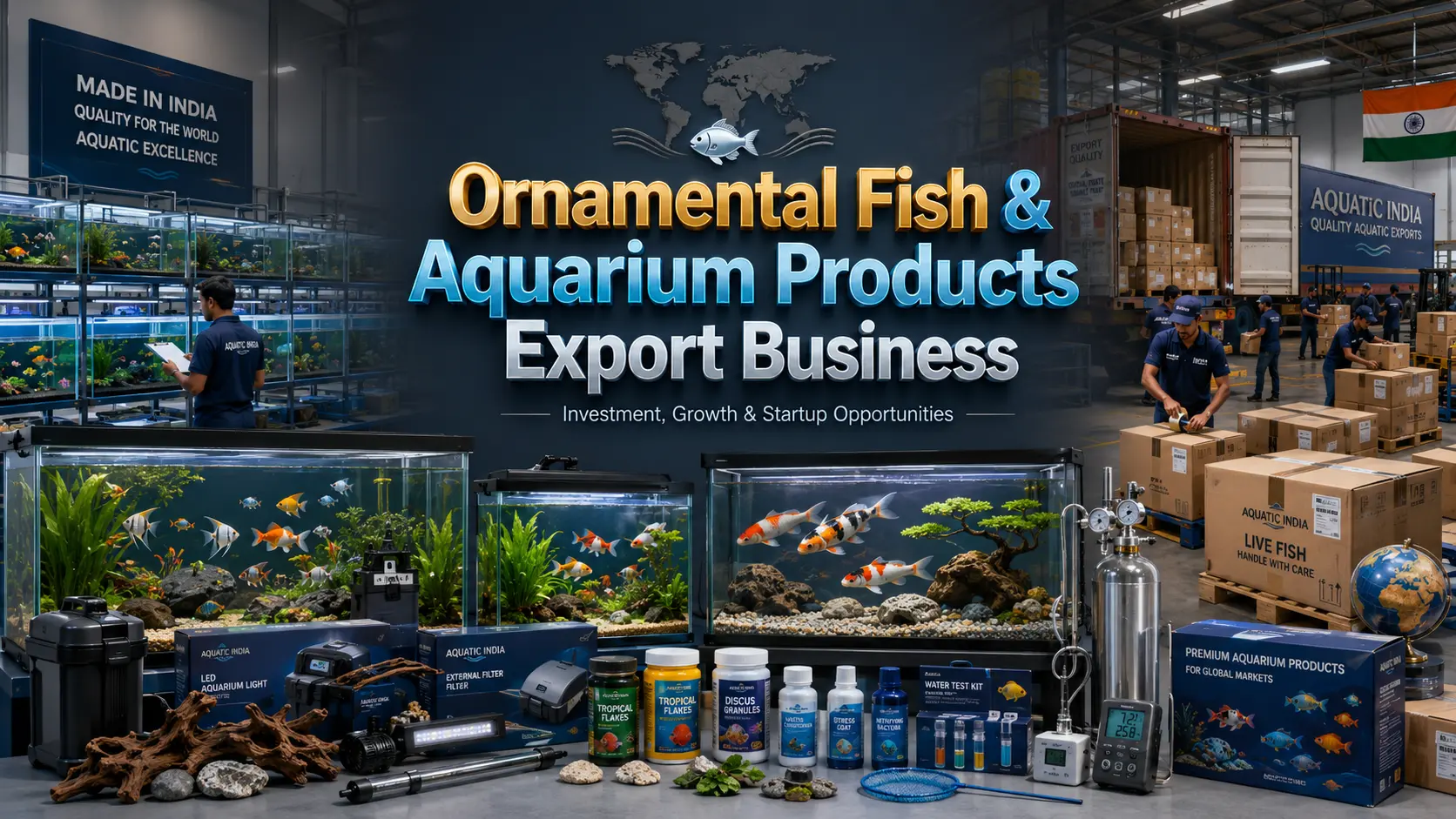
Ornamental fish and aquarium products export is one of the most unique and niche business opportunity in the marine products sector as the natural differentiation in the sector due to India’s exceptional freshwater and marine fish biodiversity which no other country in the world can easily replicate is the basic differentiator for the sector. The aquarium fish market is worth over $5 billion per year on a worldwide basis, and the hobbyist aquarium enthusiast finds himself looking for rare, colourful, healthy genetically fish species. The Northeast states of India, especially Assam, Meghalaya, Tripura, Manipur and Nagaland are blessed with dozens of endemic freshwater fish species of great value to international aquarists. MPEDA particularly encourages export of ornamental fish through its dedicated scheme, offering financial support for ornamental fish breeding units and packaging facilities as well as market development in the international market. For those businessmen in the regions where the fish is abundant, export of ornamental fish is a high-margin business with comparatively low investment and a product which international buyers are eagerly looking for.
Why Ornamental Fish Export Is a High-Margin Niche
Ornamental fish are not food, they are living art. The price of a pair of rare ornamental fish ranges from ₹500 to ₹50,000 per pair, depending on the species, color and rarity. The unit economics of an ornamentals fish export is very different from a commodity seafood – the value of a kg of frozen shrimp can be valued at ₹300 to ₹600 while the value of a kg of ornamental fish per unit number can be valued at ₹10,000 to ₹1,00,000. This unique per unit value makes ornamental fish as one of the most valuable agricultural products by weight to export to India.
India’s freshwater fish biodiversity – comprising fighting fish, gouramis, barbs, danios, loaches and many other endemic species from the Northeast – together with marine ornamental fish that occur in Kerala and Lakshadweep coral reef ecosystems provides a raw material diversity advantage, facilitating differentiated export product offerings. The world’s leading exporters of ornamental fish are Thailand, Singapore, and Malaysia, but there is some differentiation in the world’s ornamental fish natural products list that is given by the endemic species in India.
Read the Complete Book Here: Handbook on Fisheries and Aquaculture Technology
MPEDA and Government Support
The Marine Products Export Development Authority (MPEDA) has developed a separate programme for the ornamental fish, which focuses on financial assistance for the establishment of ornamental fish breeding farm, packaging materials & facilities, water quality testing equipments, air cargo export logistics and international market development which includes participation in International Aquarium Trade Fair like Aquarama (Singapore) and Interzoo (Germany).
The Department of Fisheries PMMSY offers capital subsidies for ornamental fish breeding and rearing units such as recirculating aquaculture system (RAS) infrastructure which can be used to produce ornamental fish throughout the year independent of seasonality.
Ornamental fish enterprises have the potential to create a source of rural livelihood in the Northeastern part of the country while at the same time contributing to substantial export earnings and the Ministry of Development of North East Region (DoNER) along with the state governments of the Northeast have been giving additional support to these activities.
The DGFT RoDTEP Scheme applies to the exports of ornamental fish and aquarium product. These benefits must be realized with the participation of MPEDA RCMC. Ornamental fish has a relatively low investment cost and has a very high unit value, which makes RoDTEP benefit significant for small-scale exporters.
Business Ideas in Ornamental Fish Export
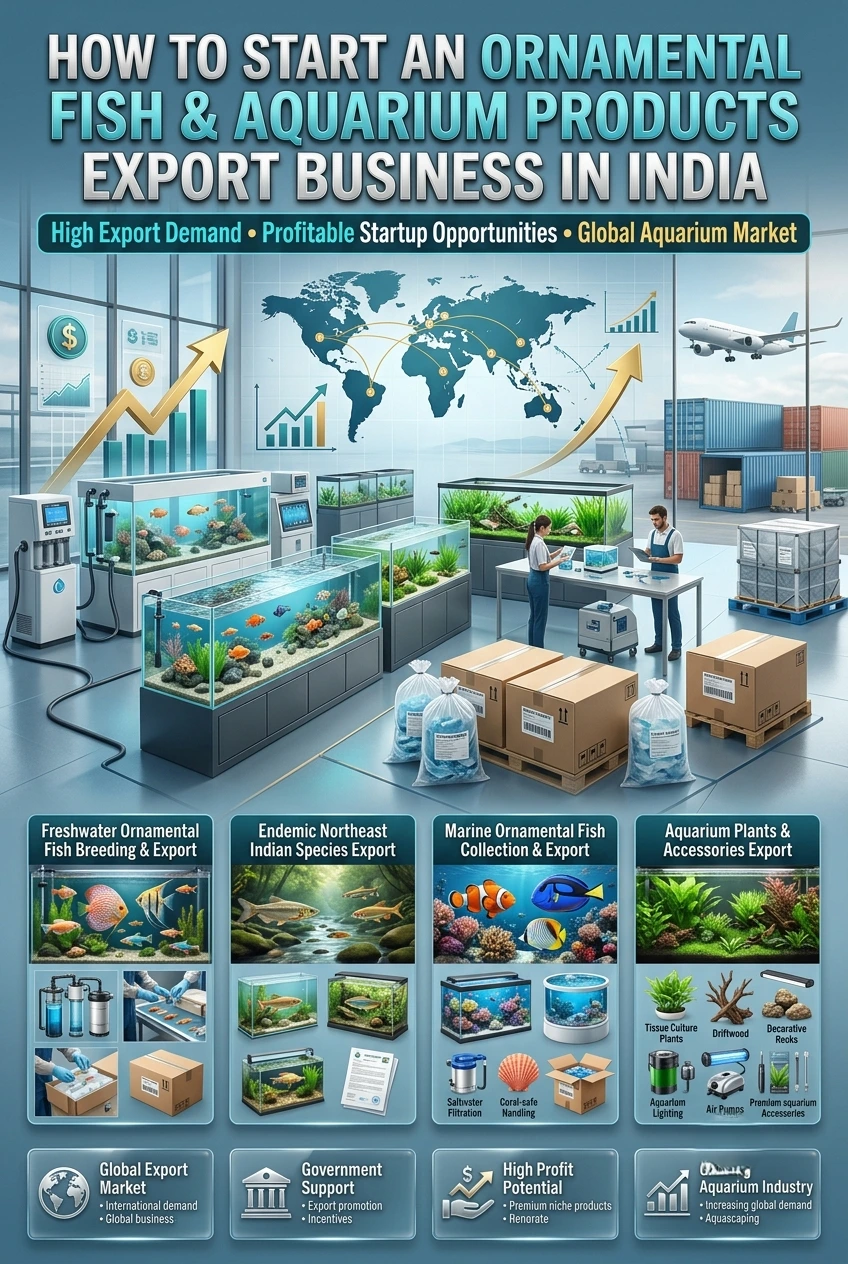
1. Freshwater Ornamental Fish Breeding and Export
The most readily available fish export business is captive breeding of popular freshwater aquarium fish, such as guppies, bettas (fighting fish), variants of goldfish, discus, angelfish, tetras, cichlids and livebearers. The investment required for medium scale commercial operation of breeding units is in between ₹10 lakh to ₹30 lakh in indoor/outdoor tanks. Exportation is by air freight in specially designed breathing bags containing oxygen in packing boxes made of Styrofoam. Main export markets are the US, UK, Germany, Netherlands and Japan. The annual export earning of ₹30 lakh to ₹1 crore can be generated by a well-managed breeding operation with a capacity of producing 50,000 to 200,000 fish per month by taking a combination of species and market linkages, depending on the combination of species and market relationships.
Build a profitable business with the right idea
2. Endemic Northeast Indian Species Export
Indian Northeast fishes such as Assam’s emerald puffer fish (Tetraodon leiurus), the endangered red-tailed black shark (Epalzeorhynchos bicolor), a number of the Badis species, Barilius species and more than a dozen other fishes endemic to the freshwater of the Indian Northeast fetch extraordinary premium prices from international specialized aquarists. The cost of investment for fish collection, quarantine and export centre in Northeast India is between ₹8 lakh and ₹25 lakh. One of the compliance issues for these species is that they must have a wildlife collection permit from a state forest department. International buyers include the rare fish importers, who serve the dedicated rare fish hobbyist community, in Netherlands, UK, US and Japan, who are prepared to pay ₹1000 to ₹10,000 per specimen for rare endemic species.
3. Marine Ornamental Fish Collection and Export
The marine ornamental fishes (fishes meant for decoration) such as clownfish, tangs, gobies, seahorses and Reef fishes are exported from Kerala’s coastal waters and Lakshadweep Island reef areas to the world market of marine aquarium fishes. Marine ornamental fish fetches even higher price as compared to their freshwater counterparts, a Blue Tang is sold for international markets for ₹2,000 to ₹8,000. Technically difficult, but possible, captive breeding of marine ornamentals for clownfish, dottybacks and some gobies; bred specimens are offered at a premium price because they are hardy and disease resistant. The investments in marine ornamental collection and export unit are between ₹15 lakh to ₹40 lakh, which includes holding tanks with marine water filtration, live packaging and CITES compliance documentation for those species in need of convention permits.
4. Aquarium Plants and Accessories Export
The aquatic plants particularly Indian aquarium plants such as Indian Fern, Ambulia, Bacopa monnieri, Hygrophila, Vallisneria, and aquatic mosses are sent out to the aquarium plant lovers all over the world. Planted aquarium trend (Dutch and Nature Aquarium styles) has given a huge boost for the demand of quality aquatic plants globally. Cost of investment for commercial aquatic plant production using either shallow water or hydroponic system is between ₹5 lakh to ₹20 lakh. Hardy plants can be easily exported in insulated moisture retaining packages. The main markets are the United States, Germany, the Netherlands and Japan. In addition to live fish and plant exports, aquarium accessories such as fish nets, breeding boxes, air pumps and decorative substrates can be sold for additional export earnings.
Get Detailed Project Report (DPR): Fisheries and Aquaculture, Fish and Marine Products, Fish farming, Processing and value added Products and Projects
Import-Export Opportunity Analysis
However, while the base for the Indian ornamental fish exports might be small, it still fares poorly compared to the country’s biodiversity. Based on the MPEDA ornamental fish export data, there has been a gradual increase in the value of ornamental fish exports over the years and the top importers are the USA, Netherlands, UK and Singapore. There is a special MPEDA ornamental fish development programme implemented to encourage the growth of exports in this segment.
Thailand, Singapore, and Malaysia hold an enormous share of the ornamental fish market globally with 70%+ in part by exporting large amounts of tropical, captive-bred fish. India’s distinctiveness comes with the export of its rare, endemic, wild-type ornamentals which these three cannot access. Entrepreneurs who focus on India’s unique biodiversity advantages — rather than competing in commodity guppy and goldfish categories dominated by Asian competitors — will find more sustainable and premium market positioning.
Indian MSME Success Stories
Several Kerala-based marine ornamental fish exporters have built small but profitable export businesses supplying marine aquarium fish to European and US importers by combining MPEDA-compliant collection permits, live packaging expertise, and direct buyer relationships with specialty marine fish importers in the Netherlands and Germany.
Aqua India, a Chennai-based ornamental fish company, built significant export business in freshwater ornamental fish by combining captive breeding of popular species with Northeast India wild-type specimen collection — offering buyers a diverse product catalogue that single-source competitors cannot match.
Northeast India-based ornamental fish enterprises — supported by MPEDA’s Northeast promotional initiatives — have demonstrated that community-based ornamental fish collection and export businesses can generate substantial rural household incomes from India’s endemic species wealth while providing international aquarium markets with genuinely rare and sought-after fish varieties.
How NPCS Supports Ornamental Fish Business Planning
We at Niir Project Consultancy Services (NPCS) provide professional consulting for the preparation of Market Survey cum Detailed Techno-Economic Feasibility Reports (DPRs) for setting up new marine products and seafood businesses. Our reports include detailed processing technology, market research and demand analysis, regulatory compliance roadmap, plant layout and equipment specifications, and complete project financials with profitability analysis. Our objective is to help entrepreneurs evaluate feasibility, profitability, and long-term scalability before investing.
Related Article: How to Start a Fish Farming Business in India
Ornamental Fish Export: Key Data Overview
| Category | Investment Range | Key Requirement | Target Markets | Revenue Potential |
| Freshwater Fish Breeding | ₹10L – ₹30L | MPEDA + FSSAI | US, EU, Japan | ₹30L–₹1 Cr/yr |
| Endemic NE Indian Species | ₹8L – ₹25L | Forest Dept Permit + MPEDA | Netherlands, UK, US | ₹20L–₹60L/yr |
| Marine Ornamental Fish | ₹15L – ₹40L | MPEDA + CITES (some sp.) | US, EU, Japan | ₹30L–₹80L/yr |
| Aquatic Plants Export | ₹5L – ₹20L | MPEDA + Phytosanitary | US, EU, Japan | ₹15L–₹40L/yr |
| Aquarium Accessories | ₹10L – ₹30L | MPEDA + FSSAI | Global hobbyist market | ₹20L–₹50L/yr |
Frequently Asked Questions (FAQ)
1. What permits are required for exporting wild-collected ornamental fish?
State forest department licenses are needed for the collection of ornamental fishes collected in the wild, a transit permit for interstate movement and CITES licenses in case the species is included in the Appendices I, II or III of the Convention on International Trade in Endangered Species of Wild Flora and Fauna. MPEDA clarifies on the permit for various species.
2. How are live ornamental fish packaged for air export?
Ornamental fish are packed in polyethylene bags with approximately one-third water and two-thirds pure oxygen, sealed with rubber bands. Multiple fish bags are packed in insulated styrofoam boxes. Box weight is typically 5 to 8 kg for airline handling. Transit time from bagging to destination should not exceed 36 to 48 hours for most tropical freshwater fish. Marine fish have stricter time limits — typically 24 to 36 hours maximum.
3. What is a Recirculating Aquaculture System (RAS) and why is it important?
RAS uses biofiltration, UV sterilization, and mechanical filtration to recycle 95-99% of water used for aquaculture, with PMMSY providing subsidies for RAS infrastructure.RAS facilities can house more fish on a smaller land footprint, require significantly less water than conventional systems and can create fish of high-quality that have less exposure to disease.RAS is useful for fish breeders raising especially sensitive or expensive ornamental fish varieties who require optimum water quality.
4. Which ornamental fish species are most commercially valuable for Indian exporters?
High-value commercial species for Indian exporters include: Betta splendens (fighting fish — particularly show-quality varieties), discus (Symphysodon species), rare cichlid species, celestial pearl danio (from NE India), endemic Barilius species, clownfish (marine), sea horses (regulated), and rare loach species from NE Indian mountain streams. Species value depends on availability, rarity, colour quality, and international collector demand at any given time.
5. Are CITES regulations a significant compliance burden for ornamental fish exporters?
Some species like seahorses (Hippocampus species CITES Appendix II), particular marine reef species and selected fresh water species are governed by the provisions of CITES. Most fresh water popular ornamental species like guppies, bettas, goldfish, tetras do not come under CITES requirements. Exporters should get to know CITES requirement for each species that they intend to export. Species wise guidelines on CITES for ornamentals fishexporters is available from MPEDA.
6. Can ornamental fish be sold through e-commerce to international buyers?
Live ornamental fish export through postal services is complex due to IATA live animal regulations, airline restrictions, and customs requirements. Most international ornamental fish trade uses dedicated air freight with IATA-compliant live animal packaging through freight forwarders specialising in live aquatic animals. However, aquarium plants, decorative substrates, and aquarium accessories (non-live) can be sold through e-commerce with standard international shipping.
Conclusion
Ornamental fish and aquarium products export is one of India’s most distinctive and highest-margin marine business ideas — where the country’s extraordinary freshwater and marine fish biodiversity creates genuinely unique product offerings that no competitor can replicate from a different geography. MPEDA’s dedicated ornamental fish development programme, PMMSY’s RAS infrastructure subsidies, and the global aquarium hobby market’s passionate and affluent buyer community create a business environment where relatively modest investment can generate significant and growing revenue. The entrepreneurs who focus on India’s biodiversity advantage — endemic Northeast species, rare wild-type specimens, and quality captive-bred marine ornamentals — will find ornamental fish to be one of the most intellectually rewarding and commercially distinctive seafood export businesses available in India today.


