





Coastal Cold Chain Logistics Business in Kerala & India
The Number That Should Embarrass Every Logistics Investor
About 30% of the marine catch in India is lost every day before it reaches a processor, exporter and consumer accounting for a loss of approximately ₹18,000 crore per year. It wasn’t because the fish was not caught in time. Not for lack of demand. The fact that there was no refrigerated vehicle available at the right harbour, at the right hour, on the right coastal route.
The length of the Indian coast is 7,516 kilometres and it includes nine marine states and two Union territories. It has a direct employment of more than 28 million in its fisheries sector. The National Fisheries Development Board (NFDB) reports that the country is the third largest fish producer in the world with contribution of almost 7.28% of the global fish production. The cold chain facilities on this coastline, however, are however decades behind in meeting demand.
The paradox is that during the same financial year, India exported marine products worth more than ₹60,000 crore. However, transport of the same produce from harbour to processor, from processor to mandis as well as from mandis to cold storage is still largely carried out in unrefrigerated tempos, open trucks and battered three-wheelers.
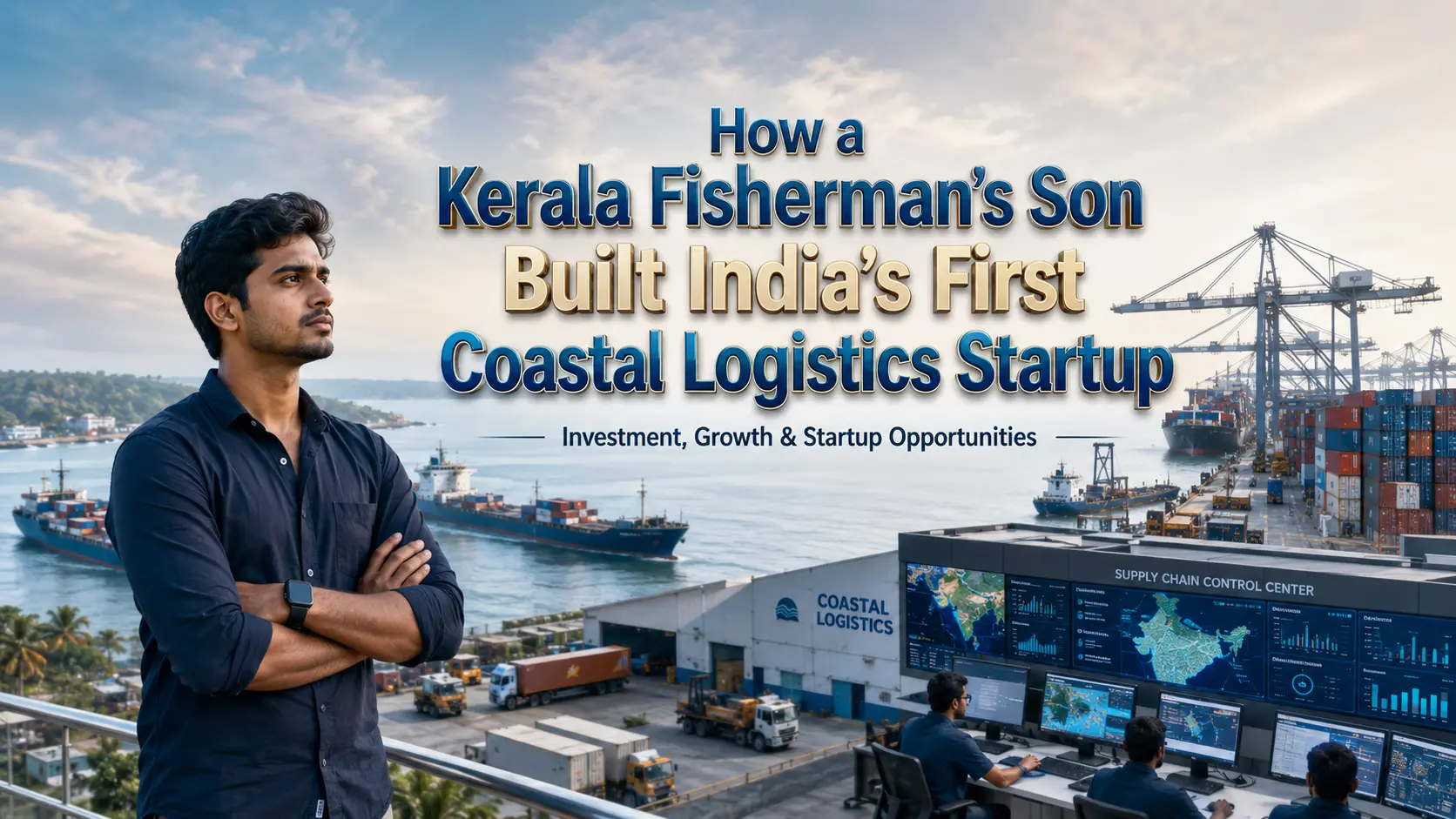
It’s the gap between the record of a world-class export industry and the broken coastal distribution chain at home, where one fisherman’s son from Kollam, Kerala, saw the opportunity that others in suits missed altogether.
Related Article: Small Scale Manufacturing in Kerala: Top Viable Business Ideas Leveraging the State’s Natural & Industrial Strengths
A Supply Chain That Has Never Worked
The deficiency of fish handling and cold chain system in India is not a new phenomenon. The National Centre for Cold-chain Development (NCCD) has repeatedly pointed out that the country just has approximately 35% of the necessary cold storage facilities in the fisheries and perishables sector. The disparity is even greater in the ‘middle mile’ (processing to market) for marine products.
The issue is with the structure. There are no inter-city cold chain networks in India at major fish-landing centres (FLCs) as per the study, viz Vinay Kumar, under Vizhinjam Fishport; Under S. K. Ramamoorthy, under Neendakara Fishport and Chilika in Odisha and Rameswaram in Tamil Nadu. A reefer truck that comes from Mumbai’s JNPT catchment will not be able to move a load of 2–3 tonne to Neendakara. It is not economically viable at the existing freight rates. So the fish is loaded into regular trucks with crushed ice and about 15-30% of the fish reaches the destination in bad condition or can’t be sold.
According to the Annual Report of the Ministry of Fisheries, Animal Husbandry and Dairying 2023, the estimated annual post-harvest loss in the marine sector is around ₹22,500 crore. This encompasses losses in the middle mile — the 50-400 km distance between the harbours and processors — and losses at the landing stage and in transit and cold store.
The top 5 most severely affected states, all with high catch volumes but underdeveloped and fragmented local logistics are Kerala, Gujarat, Tamil Nadu, Andhra Pradesh and Odisha. In these States, the number of registered reefer vehicles is less than 3200 and the total marine production is more than 35 lakh MT per annum. The math is incorrect.
TABLE 1: Key Coastal States — Marine Output, Cold Chain Gap & Route Opportunity
| State / Region | Active Fishing Ports | Annual Marine Output (MT) | Cold Chain Gap (%) | Key Coastal Route Opportunity |
| Kerala | 222 | 7.8 lakh MT | ~68% | Vizhinjam → Kochi → Mangalore |
| Gujarat | 41 major + 200 minor | 8.4 lakh MT | ~72% | Veraval → Jamnagar → Mundra |
| Tamil Nadu | 352 | 7.5 lakh MT | ~65% | Rameswaram → Tuticorin → Chennai |
| Andhra Pradesh | 57 major landing centres | 5.2 lakh MT | ~70% | Bhimavaram → Visakhapatnam |
| Maharashtra | 178 | 4.6 lakh MT | ~60% | Ratnagiri → JNPT Mumbai |
| Odisha | 4 major + 18 minor | 2.2 lakh MT | ~78% | Paradip → Bhubaneswar corridor |
Source: NFDB Annual Report, NCCD Gap Analysis, MPEDA Regional Data, CMFRI Estimates
Why the Window Is Open Right Now
The three policy tailwinds are aligned and capital is now flowing towards India’s coastal logistics deficit for the first time in memory.
The Pradhan Mantri Matsya Sampada Yojana (PMMSY) with an outlay of ₹ 20,050 crore over five years, specifically provides for cold chain assets, such as refrigerated vehicles, ice plants, insulated fish transport boxes and value addition centres at landing sites. MSME registered operators will be eligible for 40% capital subsidy (60% for SC/ST and women promoters) on assets used. This is something that most first-generation coastal logistics operators have yet to utilise due to a lack of awareness.
Second, the Sagarmala Programme under the Ministry of Ports, Shipping and Waterways is ongoing for funding last mile connectivity for coastal connectivity projects in major and minor ports. Several states have sanctioned Sagarmala funds for installing reefer facilities at secondary landing centres, such as Kerala, Gujarat, Tamil Nadu. Private MSME operators receive grants, though they are less sought after than needed.
Third, marine products’ exports from India have expanded by more than 12% per year in the last decade, according to data from MPEDA (Marine Products Export Development Authority). All incremental tonnes that go out of the country must be handled at home. The capacity constraint is not due to the capacity of the export processors (shrimp peeling plant in Nellore, tuna processing plant in Kochi, surimi factories in Mangalore), but because of inconsistent arrival of supply. They can increase throughput without making any new plant investment by a reliable middle-mile coastal logistics operator.
Worse, add to it the CGTMSE scheme (Credit Guarantee Fund Trust for Micro and Small Enterprises) that offers collateral-free loan guarantees up to ₹2 crore for MSMEs and the financing barrier that once held back first-generation founders gets smaller.
Access Complete Business Plan: Kerala Business Opportunities Guide
How to Set This Up: A Ground-Level Playbook
Step 1: Choose Your Route Before You Buy Your First Vehicle
Do not consider ‘how do I start a business’. Don’t consider ‘how do I start a business’. Consider owning a route 100%. The Neendakara–Kochi corridor. The Veraval–Rajkot cold chain lane. The Rameswaram – Madurai Fish corridor. Select a 100-300 km area in which you have personal contacts with landing agents, fish merchants and processors. Your “moat” is your domain knowledge. When a Mahindra Blazo reefer truck comes from an unknown source, there’s nothing different between it and yours — it’s a personal network at the source end that makes you different.
Step 2: Minimum Investment Required
The cost of a single vehicle, single route coastal logistics micro-unit is around ₹35-45 lakh, which covers one used refrigerated truck (Tata Ultra or Mahindra Blazo, approximately ₹16-22 lakh), pre cooling pod at source harbour (₹5-8 lakh), working capital for initial three months (₹5-6 lakh) and licensing and registration costs (under ₹1 lakh). The recommended configuration, comprising two vehicles and a hired cold holding space, costs between ₹90–110 lakh.
Step 3: Registrations and Licences
You’ll need the following:
- Udyam Registration (MSME) at udyamregistration.gov.in — Free and is quick to complete (under 30 minutes).
- GST Registration (required when turnover is more than ₹20 lakh in majority of states)
- FSSAI Transport Licence (required for transporting food products including fish)
- A State Transport Permit is necessary to transport goods vehicles across the state (depending on state).
- If you are planning to serve export processors, then you are required to use IEC Code (Importer-Exporter Code) which can be obtained from the DGFT portal.
Step 4: Equipment and Cold Chain Assets
The main thing you have is the refrigerated transport vehicle. The workhorse at the micro-MSME stage is the Tata Ultra Reefer or Mahindra Blazo Reefer that ranges between 3.5 to 7 tonne. The cost of fish boxes in insulated packages varies from ₹3,000 to ₹6,000 per box and are supplied by the various Ahmedabad and Kochi suppliers. The pre cooling chamber at the landing site, which uses a direct expansion unit, costs ₹5–8 lakh and cuts up to 40% of first leg spoilage. Once you install GPS fleet tracking (subscription-based, around ₹8,000 per vehicle, for example on Vamosys or LocoNav) your route is all data-driven from day one.
Step 5: Raw Material (Supply) Sourcing
It’s not fish, it’s transport contracts that are your ‘raw material’. The first three business opportunities you should pursue are: (1) A fish processing business that is already providing general cargo services and is losing about 15–20% of the value of its products; (2) A fisheries co-operative that requires a regular supply of fish to urban cold storage and (3) An aquaculture business (shrimp or tilapia) with a demand for live fish. West Godavari and Krishna districts in AP are home to maximum shrimp ponds in India with majority of them employing poor transportation systems. This is your introduction point.
Read the Complete Book Here: Handbook on Fisheries and Aquaculture Technology
Step 6: Team Size to Start
A micro-unit requires a minimum of four staff members: two drivers (one for each shift or vehicle), one loading & documentation staff at the source harbour, one collection & client relations staff (usually the founder) and a part-time accountant. There is no need for there to be a formal management layer until you reach ₹1 crore monthly revenues.
Timeline: Registration to First Delivery
After obtaining funding, you will be operating within 60–90 days. Udyam registration: Day 1. Vehicle procurement: 15–30 days. FSSAI and GST: 15–20 days. Installation period for cold pods: 25-40 days. First delivery contract: start negotiating from Day 1 in parallel. Founders who delay and wait until they have all the licences in their hands before approaching the client, lose those 45-60 days without a purpose.
TABLE 2: Investment Breakdown — Minimum vs. Recommended Setup (INR)
| Cost Head | Minimum Setup (₹) | Recommended Setup (₹) | % of Total Capex |
| Refrigerated Transport Vehicles (2–3 units) | 18,00,000 | 45,00,000 | 38–42% |
| Cold Storage Pod / Pre-cooling Unit | 8,00,000 | 22,00,000 | 18–22% |
| Dock & Loading Infrastructure | 3,50,000 | 9,00,000 | 8–10% |
| GPS & Fleet Management Software | 1,20,000 | 3,50,000 | 3–4% |
| Working Capital (3 months) | 6,00,000 | 14,00,000 | 14–16% |
| Regulatory, Legal & Licensing Fees | 85,000 | 1,50,000 | 1–2% |
| Contingency & Miscellaneous (10%) | 3,75,000 | 9,50,000 | 9–10% |
| TOTAL ESTIMATED CAPEX | ₹41,30,000 | ₹1,04,50,000 | 100% |
Note: Figures are estimates for a Kerala/Andhra Pradesh coastal route. Vehicle costs vary by state and age of vehicle. Working capital assumes 3 months of fuel, driver wages, and minor maintenance.
Identify high-growth industries before others do
What the Numbers Actually Look Like
Gross monthly revenue is ₹3.6-4.4 lakh for a single-vehicle, single-route service with an average freight rate of ₹18,000-22,000 per trip (typical for a 200 km refrigerated coastal service) operating 20 trips per month. In the 1st year, with a 60% utilisation rate (which is realistic), the revenue is ₹2.16 lakh to ₹2.64 lakh per month.
Monthly operating costs for one vehicle: driver wages ₹22,000–28,000, fuel ₹55,000–65,000 (at 8–10 km/litre on a loaded reefer), vehicle maintenance ₹8,000–12,000, cold unit electricity/diesel ₹10,000–14,000, toll and port entry fees ₹6,000–9,000. Total monthly opex per vehicle: ₹1,01,000–1,28,000.
Gross margin at 60% utilisation: 48- 52%. Net margin (after loan EMI, depreciation and overheads): 18-24%. These margins are true at any scale. A 5 vehicle operation with 80% utilisation with an investment of ₹1.1 crore yields ₹70-85 lakh as gross earnings annually, the payback takes 14-18 months.
Revenue at 100% utilisation, 2 vehicles: ₹7.2 – 8.8 lakh monthly. Capital expenditure: ₹41 lakh (Min) to ₹1.05 crore (Recommended for 2+2 setup). Average utilisation of the recommended set-up = 20-26 months payback period — an unusually short period for a logistics infrastructure business.
TABLE 3: Applicable Government Schemes — Eligibility and Benefit for Coastal Logistics MSMEs
| Scheme Name | Administering Body | Max Benefit | Relevance to Coastal Logistics |
| PMMS (Pradhan Mantri Matsya Sampada Yojana) | Ministry of Fisheries, GoI | ₹20,050 Cr (national outlay) | Covers cold chain infra, boats, ice plants; 40–60% subsidy on eligible assets |
| CGTMSE | SIDBI / Ministry of MSME | Collateral-free loan up to ₹2 Cr | Ideal for first-time logistics operators with no fixed property to pledge |
| MUDRA – Kishor & Tarun | MUDRA Ltd / Scheduled Banks | ₹5 lakh – ₹10 lakh | Working capital for fuel, wages, early-stage route operations |
| PMEGP (Prime Minister’s Employment Generation Programme) | KVIC / Ministry of MSME | 15–35% capital subsidy | New enterprise setup; eligible if promoter is from SC/ST/OBC/coastal community |
| Sagarmala Programme | Ministry of Ports, Shipping & Waterways | Infra grants up to ₹50 lakh for last-mile | Port connectivity, last-mile logistics, coastal shipping support; direct alignment |
| Udyam Registration + GeM Portal | Ministry of MSME | Priority in govt procurement | Enables B2G contracting for state fisheries departments, NFDB tenders |
Source: Ministry of Fisheries (pmmsy.dof.gov.in), SIDBI/CGTMSE (cgtmse.in), KVIC (kvic.gov.in), Sagarmala Secretariat (sagarmala.gov.in)
Where to Get a Rigorous Feasibility Study Done
Coastal logistics entrepreneurs would benefit from a techno-economic feasibility report specific to the project before committing capital. The consultancy firm, Niir Project Consultancy Services (NPCS) based in Delhi has been serving MSME sectors like cold chain, fisheries logistics and food processing with Detailed Project Reports (DPRs), plant layout designs, financial models and end-to-end MSME consultancy solutions for more than 30 years. They are organised according to the requirements of bank financing and government subsidy applications. For those who are thinking of entering the business of cold chain logistics in the coastal area or allied sectors, niir.org and entrepreneurindia.co have specific reports on these sectors which include route economics, regulatory aspects, machinery sourcing and project cost estimation which are useful for everyone preparing a formal business plan or approaching a lender.
Your Next Step Is Simpler Than You Think
Coastal logistics is not a technical issue. It is not a capital issue, PMMSY subsidy and CGTMSE guarantee together a viable first vehicle. It isn’t a market issue — 35 lakh metric tonnes of fish must be transported annually along India’s coast and most do not travel well.
It’s an execution and conviction issue. The winners here will be the entrepreneurs who have the best pitch decks, not the ones who got the best seats. It is they who already have a landing agent at Neendakara or a shrimp exporter at Bhimavaram – who are ready to step in at 4 AM when the trawlers arrive.
Your next step: Find one 200 km coastal route that you know personally, call on three different fish processors or cooperatives on that route this week and ask them one question: What percentage of your product is damaged or degraded on transit? The solution will seal the offer for you.
ENTREPRENEUR SPOTLIGHT
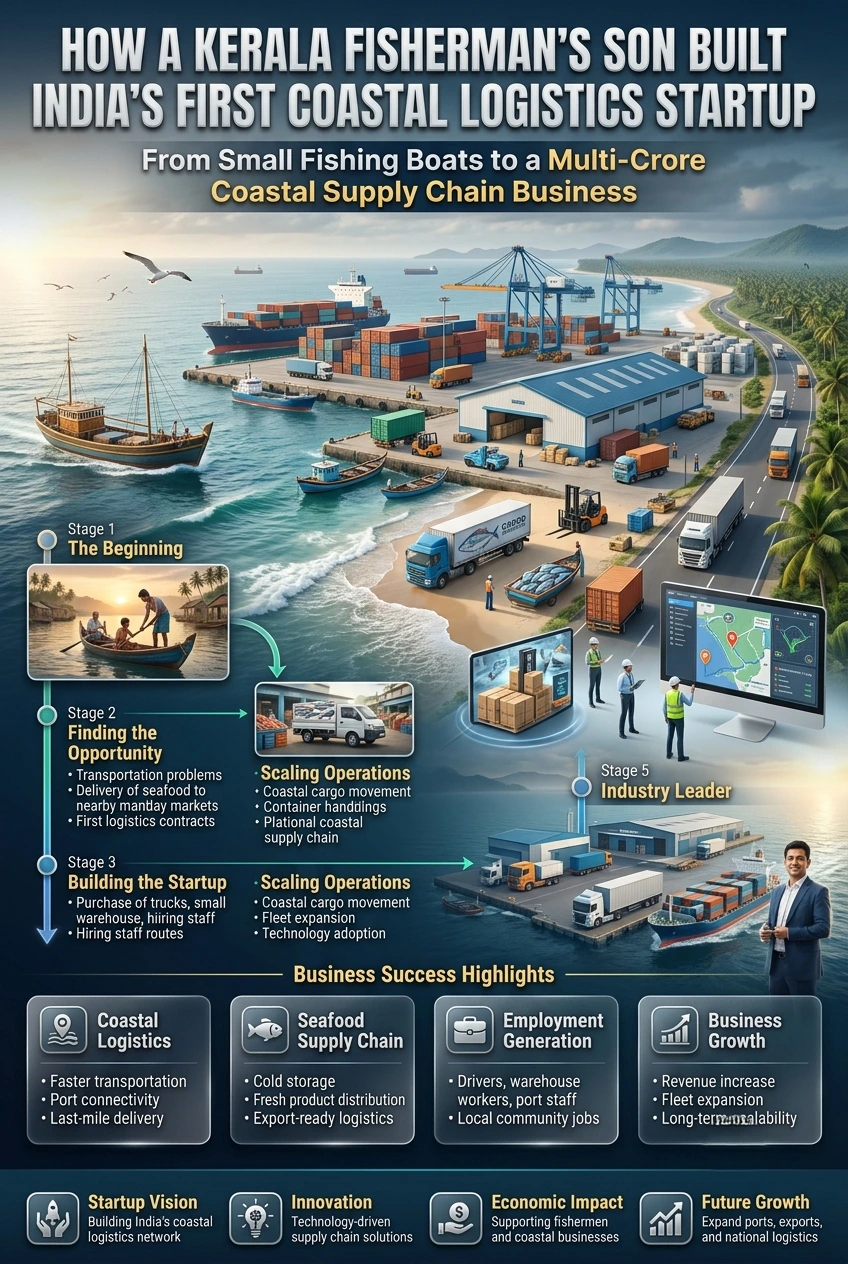
Shaji K., Founder, KeralaCoast Cold Freight (Representative Profile) Kollam, Kerala | Annual Revenue: ~₹1.2 crore | Fleet: 4 refrigerated vehicles A third-generation fisherman’s son with no formal logistics training, Shaji started with one borrowed refrigerated tempo and a single weekly contract with a Kochi-based fish processor. He built his client base entirely through the fishing cooperative his father had joined — spending two years as an informal intermediary before buying his first vehicle. His key lesson: ‘I never pitched myself as a logistics company. I told every processor I was a fisherman who had a truck. That line got me in the door every single time.
Frequently Asked Questions
Q1. What is the minimum investment needed to start a coastal cold chain logistics unit?
A micro-unit with one second-hand refrigerated vehicle and basic cold infrastructure can be launched for ₹35–45 lakh, including working capital. A minimum 12-15 lakh from the promoter with a 40% subsidy on eligible assets under PMMSY along with CGTMSE covered collateral free loan. A two-vehicle recommended setup costs ₹90–110 lakh before subsidies.
Q2. What licences and registrations are mandatory?
At the minimum level these include: Udyam MSME Registration, GST Registration (if turnover is more than 20 lakh), FSSAI Transport Licence (Food Safety and Standards Authority of India), state level commercial transport permits. For operators supplying export processors, an Importer-Exporter Code (IEC) from DGFT is also necessary. All registrations together take approximately 30–45 days and cost under ₹1 lakh.
Q3. Where does the fish supply (cargo) come from and how do I find clients?
Your cargo comes from fish processors, aquaculture farms, state fisheries cooperatives, and export units. The best client acquisition strategy in this sector is not cold calling — it is showing up at the landing centre at 4 AM for three weeks and talking to the agents. Andhra Pradesh’s Krishna-Guntur belt (shrimp farms), Kerala’s Neendakara-Kollam corridor, and Gujarat’s Veraval-Saurashtra cluster are the three highest-density sourcing zones.
Q4. What kind of profit margins can I expect?
At standard coastal freight rates of ₹16,000–22,000 per trip and average utilisation of 65–70%, gross margins run at 48–55%. Net margins after EMI, fuel, and wages settle at 18–24% — higher than general freight by 8–10 percentage points, because of the scarcity of reefer vehicles on most coastal routes. At full capacity across two vehicles, annual net earnings of ₹25–35 lakh are achievable by the second year of operations.
Q5. Which government schemes specifically support this business?
The Pradhan Mantri Matsya Sampada Yojana (PMMSY) is the most direct — it covers refrigerated vehicles and cold infrastructure at 40–60% subsidy. pmmsy.dof.gov.in has the application guidelines. The Sagarmala Programme funds port-linked last-mile logistics infrastructure. CGTMSE provides collateral-free credit guarantees up to ₹2 crore. PMEGP offers 15–35% capital subsidy for first-time entrepreneurs from priority categories. All schemes require Udyam MSME registration as a base prerequisite.
Q6. Where can I get a Detailed Project Report (DPR) for bank financing?
Niir Project Consultancy Services (NPCS) at niir.org prepares sector-specific DPRs that include machinery layouts, financial projections, raw material sourcing maps, and regulatory compliance checklists — structured for bank loan and subsidy applications. Entrepreneur India (entrepreneurindia.co) also publishes detailed feasibility studies for fisheries cold chain and coastal logistics segments. Both are accepted by nationalised banks and SIDBI for loan appraisals.


