





Transformer Manufacturing Business
India’s Power Grid Is Growing. The Business Ideas Are Right Here.
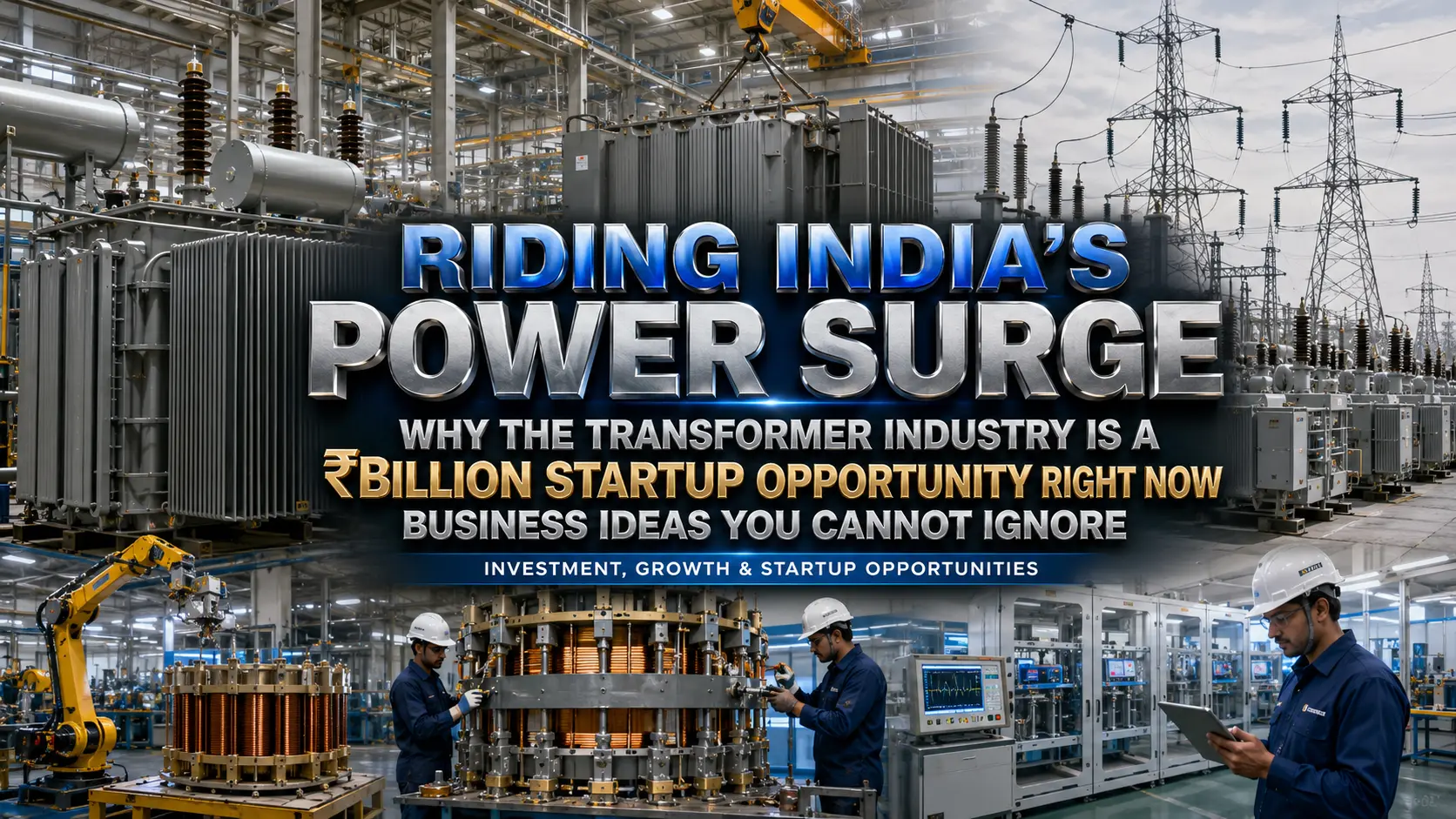
India is rapidly electrifying at a speed that has rarely been seen in the world before China in the ’90s. In the background of every new solar installation, every EV charging station, every industrial estate and industrial use, and every rural dwelling that first gets power from a new installation is a transformer. But despite this huge opportunity, startup founders and first-generation manufacturers have mostly walked away. This is a wrong thing to do.
A picture worth a thousand words is the one painted by the Ministry of Heavy Industries’ Annual Report that has been published by the Government of India. The production of Power and Distribution Transformers (PDT) and special transformers have increased by 134% in the last 5 years from 64,949MVA to 1,52,071MVA. This is not a cycle. This is NOT a cycle. This is the structural demand. And it’s developing very specific business concepts for entrepreneurs who know where the gaps are.
It is for those with dreams of entering the Transformer business with their eyes wide open, be they an entrepreneur or a startup founder or an MSME investor. This will include the drivers for demand, government incentives, practical areas to enter, import and export considerations and some of the key elements needed to make a profitable business in this space.
Why the Transformer Industry Deserves Serious Attention
Let us be direct. The transformer industry is not a pretty one. Doesn’t appeal to VC money. It doesn’t usually receive attention in the news. However, it is one of the most policy protected, certain-demand manufacturing segments in India today. For this reason, for founders interested in manufacturing and industrial ventures, it’s a much more promising prospect than some digital-first business ideas.
This trend is clearly reflected in the statistics provided by the Ministry of Heavy Industries. This increase in production for small transformers has been from 6,300 thousand units to 17,054 thousand units during the same period. The combined total of electrical transformers, static converters and inductors exceeded 17,000 thousand units. These are not expectations sales forecasts. These are real production data from the registered manufacturing units.
Moreover, the main demand side – State Electricity Boards, Power Grid Corporation of India (POWERGRID) and industries – are in the middle of multi-year procurement programmes. POWERGRID has an enormous transmission expansion CAPEX plan. Transformer upgrades at all substations are needed for integration of renewable energy. The demand layer of EV charging infrastructure is a new one. Speculative trading does not exist in the market. It is contracted.
Get Detailed Project Report (DPR): Explore the Complete Renewable Energy Projects
The Renewable Energy-Transformer Connection
India has set itself lofty goals for renewable energy. For every MW of solar or wind energy connected to the grid, there will be step-up transformers at the generation location and distribution transformers at the consumption site. In addition, small distribution transformers are required for each rooftop solar project, which are rapidly increasing in scale in the wake of government schemes. As a result, the demand for the transformer associated with renewable energy is huge and constantly increasing.
EV Charging and the Urban Power Demand Surge
EVs are more than a transportation solution. They’re a power infrastructure tale. Fast EV chargers have a high-power demand, and need to be connected to a dedicated transformer at the EV charging station. The need for small, efficient distribution transformers is growing rapidly as cities expand their EV charging infrastructure. This makes it possible to have a niche that new manufacturing companies can go for a targeted product development.
Get Detailed Insights from This Book: Handbook on Electric Vehicles Manufacturing
Government Policies and Business Incentives That Actually Matter
Recently, the Indian government has been very proactive in promoting the transformer industry by directly issuing policy measures and indirectly investing in infrastructure. Those entrepreneurs who grasp them can substantially mitigate their risk and optimize project economics.
Quality Control Orders — A Market Shaper
The Ministry of Heavy Industries has notified Electrical Transformers (Quality Control) Order for Oil – Immersed Distribution Transformers up to 2500kVA, 33kV. This is important for two reasons. The first is that it increases the standard of the product, making it difficult for the import of products with low quality to compete with manufacturers in India. Second, it is establishing a compliance ecosystem (testing, certification, calibration, and inspection) for itself, a business opportunity. It’s possible to consider BIS certification consulting and testing laboratory services as separate businesses for startups.
The list of mandatory quality orders has been updated by Bureau of Indian Standards (https://www.bis.gov.in) for details on applicable quality standards and BIS certifications.
MSME Credit and Subsidy Schemes
Qualifying MSMEs in the transformer component manufacturing and assembly segment can avail of the Credit Guarantee Fund Trust for Micro and Small Enterprises (CGTMSE) for collateral-free loans up to ₹5 crore to eligible MSMEs. The Prime Minister’s Employment Generation Programme (PMEGP) provides subsidy of up to 35% of the project cost for manufacturing unit established in the rural areas. Further, the Technology Upgradation Fund Scheme (TUFS) is available for capital investment for the modernisation of electrical manufacturing plants.
To check out the latest guidelines of MSME scheme, go to the MSME Ministry website (https://msme.gov.in).
PLI and make in India Push
Domestically produced electrical components have been in demand due to the implementation of the Production Linked Incentive (PLI) Scheme for White Goods and Capital Goods. At this stage, transformer companies are not directly included in the transformer-specific PLI, but companies that provide their services to power equipment manufacturers will benefit from the capital goods PLI. Moreover, the Public Procurement (Preference to Make in India) Order announced by MHI offers a price preference to the domestic manufacturers on government tenders, which is the main market for transformers.
The Make in India portal (https://www.makeinindia.com) provides an opportunity to the entrepreneurs to explore investment facilitation and incentive mapping for specific sectors.
Startup India and DPIIT Registration
Transfomer startups are eligible to register under Startup India and avail of the following benefits: tax exemption, fast track patent process and a simplified compliance procedure. The DPIIT (Department for Promotion of Industry and Internal Trade) (https://dpiit.gov.in) portal allows this registration and helps startups avail the opportunities available in government procurement under GeM (Government e-Marketplace) platform, an extremely important platform for small transformer manufacturers who are trying to reach out to SEB and Public Utility buyers.
Choose the right startup backed by real market demand
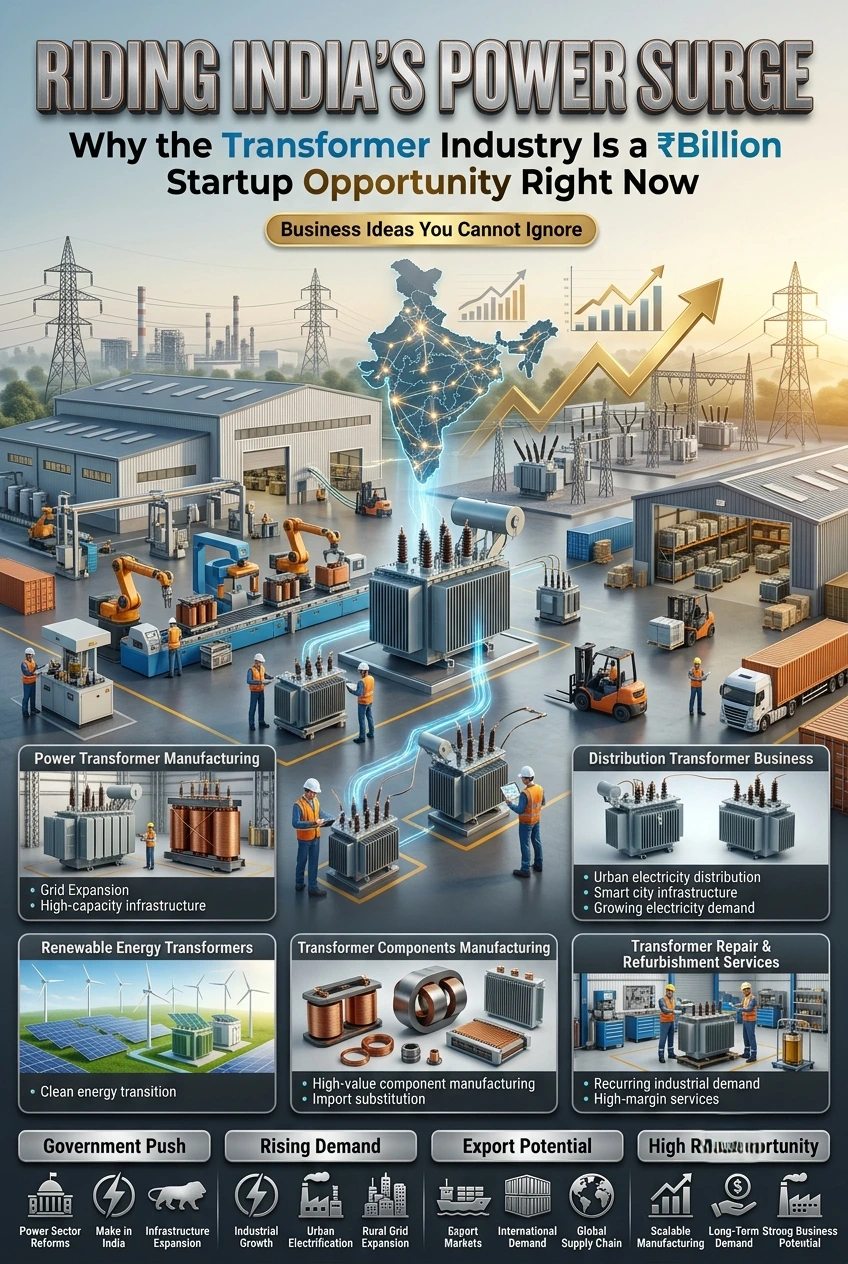
Business Ideas for Entrepreneurs: Where to Enter the Transformer Industry
The transformer industry is not one and the same. It has a multi-layer value chain from raw material processing to manufacture of components and finished product assembly with maintenance services. Smart entrepreneurs don’t have to fight BHEL or existing OEMs in a direct battle. Rather, they can establish particular segments in which capital demands can be satisfied, demand can be guaranteed and margins can be healthy. These are the most practical business ideas that make sense in terms of business action.
1. Distribution Transformer Manufacturing (Small and Medium Units)
The distribution transformer is the highest-volume product in India’s transformer market, where the voltage supplied by the power company is stepped down from 11kV or 33kV to 415V, which can be used in the home. Over 5-year period, the small transformer production has increased from 6,300 thousand units to more than 17,000 thousand units. This scale is telling us a significant message: the demand is spread out across thousands of procurement orders from state electricity boards, DISCOMS and industrial estates. No one manufacturer can meet all these needs. Hence, a professionally managed regional manufacturing plant, properly certified by BIS and competitively priced, can develop a strong order book of local utilities and government contractors.
The overall investment need for a small to medium size distribution transformer plant is in the range of ₹1.5 crore to ₹5 crore depending on plant capacity, site location and degree of automation. Raw materials are CRGO (Cold Rolled Grain Oriented) silicon steel plates for cores, enamelled copper winding wire, insulating oil and pressboard. The manufacturing process includes core lamination, coil winding, core-coil assembly, tanking, oil filling and testing. In this segment margins are moderate (12-18% net) and order consistency more than makes up for these margins.
2. Transformer Core (CRGO) Processing and Slitting Unit
The processing of CRGO silicon steel is an independent business opportunity that is often ignored by most entrepreneurs, while the raw material used is the most important in the production of transformers. CRGO is commonly supplied in master coils and must be slitted to very narrow widths for use in core lamination. Often, small transformer companies lack the slitting ability in-house and hire out slitting service.
The approximate equipment cost for a CRGO slitting & cutto length machine is ₹80 lakh to ₹1.5 crore and can be used by various transformer manufacturers in a particular area. It’s basically a “manufacturing service” — you take an intermediate material, process it, and then supply a very precise intermediate material. As the data indicates, transformer production volume is well on its way to a strong upward trend, and demand is directly proportional to production volume.
3. Transformer Oil Reconditioning and Filtration Services
All oil-immersed transformers (and most of the distribution transformers in India) must be tested, filtered and reconditioned periodically so as to maintain their insulating property and prevent failure. The State electricity boards have tens of thousands of transformers installed in their network. The reconditioning market is dominated by unorganised reconditioners. A start-up can launch a professional transformer oil testing and filtering service business with relatively low capital expenditure with mobile filter, certified lab testing and service contract with DISCOMs. This is a service-based manufacturing business idea which doesn’t need a big factory space but can give steady and predictable cash flows.
4. Speciality and Niche Transformer Manufacturing
Special transformers for welding, traction and electric furnaces are specifically referred to. These are products with lower volumes and higher margins than conventional distribution transformers. These are niche applications where small manufacturers can compete – big OEMs don’t find it economical to serve small volumes of welding transformers for industrial users, isolation transformers for IT infrastructure and data centres and step-down transformers for lab equipment. If a startup has a limited number of technical capabilities, say in EV charging station transformers or in solar inverter interface transformers, it can establish a defensible market niche with a single or two types of transformers.
Related Article: How to Start a Solar Farm Business in India: Investment, Land & Profit Guide
5. Transformer Testing and Calibration Laboratory
As a part of the mandatory Quality Control Orders, distribution transformers must be BIS certified and the demand for third party testing and calibration laboratories is steady. There are currently few accredited testing facilities available in key industrial cities. The opportunity is clearly there to establish NABL accredited transformer testing labs in tier-2 and tier-3 cities like Coimbatore, Rajkot, Aurangabad, Ludhiana etc. where there are many small transformer manufacturing units but there is no convenient access to testing lab. Testing equipment and NABL accreditation is an initial investment investment which generates a recurring revenue stream from testing fees, calibration contracts and certification support, making this a solid long-term enterprise.
Import-Export Opportunity Analysis for New Startups
The Indian transformer industry is in a transition phase — from importing top of the range transformer technology to becoming a credible exporter of standard and medium complexity transformers. This change is laying some special groundwork for new ventures.
From imports, India brings huge quantities of CRGO silicon steel, high-grade enamelled copper wire and special insulating materials from such nations as Japan, South Korea and Germany. Entrepreneurs can tap into import substitution manufacturing (ISM) segment for raw materials and components of transformer, which is actively promoted by the industrial policy of DPIIT.
Indian transformer companies have already proved their competitiveness in the Southeast Asian, African and Middle Eastern markets on the export front. Countries such as Bangladesh, Sri Lanka, Kenya, Tanzania and the Gulf states are actively buying the distribution transformers from India. The Indian capital goods exporters get export credit, export market intelligence and buyer-connect support from the Export-Import Bank of India (EXIM Bank) and the Engineering Export Promotion Council (EEPC) (https://www.eepcindia.org ). A new manufacturer of transformers could be in a position to enter markets with less “harsh competition” and, in many cases, more favourable prices than the domestic tender market.
The DGFT (Directorate General of Foreign Trade) (https://dgft.gov.in) portal is the first place to look for trade statistics, import-export data at HS code level and competitor country analysis.
Indian MSME Success Stories in the Transformer Sector
Transformers and Rectifiers India Limited (TRIL)
Founded by Jitendra Mamtora, Transformers and Rectifiers India Limited (TRIL) is one of India’s most respected transformer manufacturers, headquartered in Ahmedabad. The company began as a small manufacturing unit and scaled methodically by focusing on high-voltage and special application transformers — segments that the large PSUs underserved. Mamtora’s strategic decision to invest in technical capability and product range expansion rather than competing only on price gave TRIL access to power sector contracts that smaller competitors could not qualify for. The lesson for new entrepreneurs is clear: technical differentiation is a more durable competitive moat than cost alone in the transformer sector.
Voltamp Transformers Limited
Voltamp Transformers, also based in Gujarat, built its business on dry-type transformers — a specialised category used in buildings, hospitals, and environments where oil-immersed transformers are not suitable. The promoters identified an underserved niche within the broader transformer market and invested in becoming the most credible player in that specific segment rather than competing across the entire product range. This focus strategy allowed Voltamp to command premium pricing and build long-term relationships with EPC contractors and building developers. For MSME founders, this is a masterclass in niche focus: pick one product category, own it completely, and build your reputation around technical excellence.
Indo Tech Transformers Limited
Indo Tech Transformers, based in Tamil Nadu, is another strong example of an Indian MSME that scaled into a public-listed company. Starting with distribution transformers for Tamil Nadu’s electricity board, Indo Tech expanded its product range and customer base systematically. The key decision that distinguished Indo Tech’s growth was early investment in testing and quality infrastructure — which allowed them to win high-value contracts from POWERGRID and other central government bodies at a time when most regional players were limited to state-level procurement. For new entrepreneurs, the takeaway is straightforward: investing in quality certification and testing capability early in the business lifecycle opens doors to higher-value buyers.
How Feasibility Research Can Save Your Capital — and Your Business
One of the most common mistakes first-generation entrepreneurs make in the transformer sector is underestimating the complexity of project economics. Raw material prices fluctuate. CRGO steel sourcing requires careful supplier management. Machinery selection — particularly for core cutting, coil winding, and oil processing — directly affects product quality and production efficiency. Getting these decisions right before committing capital is essential.
At Niir Project Consultancy Services (NPCS), we prepare professional Market Survey cum Detailed Techno-Economic Feasibility Reports (DPRs) for entrepreneurs planning to set up transformer manufacturing and related businesses. Our reports include detailed manufacturing process documentation, market research and demand analysis, process flow diagrams, product mix and capacity planning, machinery and raw material sourcing details, and complete project financials with profitability analysis. Our objective is straightforward: help entrepreneurs evaluate feasibility, understand profitability, and plan for long-term scalability — before a single rupee of capital is committed.
Whether you are planning a distribution transformer unit, a CRGO processing line, or a transformer testing laboratory, a well-structured DPR is the single most important document you will need — for bank financing, investor conversations, and your own decision-making clarity.
India Transformer Sector — Production Growth Overview
The following data is sourced from the Ministry of Heavy Industries Annual Report (Government of India):
| Product Category | Base Year Production | Latest Year Production | Growth (%) |
| PDT & Special Transformers | 64,949 MVA | 1,52,071 MVA | 134% |
| Small Transformers | 6,300 Th. Nos. | 17,054 Th. Nos. | 171% |
| Electrical Transformers, Static Converters & Inductors | 11,565 Th. Nos. | 17,095 Th. Nos. | 48% |
Source: Ministry of Heavy Industries Annual Report 2025-26, Government of India
Estimated Project Economics by Business Model
| Business Model | Approx. Investment | Capacity/Scale | Estimated Revenue Range | Net Margin |
| Distribution Transformer Mfg. | ₹1.5–5 Cr. | 500–2000 KVA/month | ₹3–12 Cr./year | 12–18% |
| CRGO Slitting & Processing | ₹80 L–1.5 Cr. | 50–150 MT/month | ₹2–5 Cr./year | 15–22% |
| Transformer Oil Reconditioning | ₹30–70 L | Mobile + Fixed Units | ₹80 L–2 Cr./year | 20–30% |
| Speciality/Niche Transformer Mfg. | ₹1–3 Cr. | Custom Orders | ₹2–8 Cr./year | 20–28% |
| Testing & Calibration Lab | ₹1–2.5 Cr. | NABL Accredited | ₹1–4 Cr./year | 25–35% |
Note: These are indicative estimates based on industry benchmarks. Actual figures will vary based on location, capacity, product mix, and market conditions. A detailed DPR is recommended before finalising investment decisions.
Frequently Asked Questions (FAQ)
Q1. What is the minimum investment required to start a transformer manufacturing business in India?
The investment required depends heavily on the product type and capacity. A small distribution transformer unit can be set up for ₹1.5 crore to ₹3 crore including machinery, civil work, and working capital. Speciality transformer units may require ₹1 crore to ₹5 crore. Service-based businesses like oil reconditioning or testing labs can start with ₹30 lakh to ₹1.5 crore. In all cases, a detailed project report is essential before finalising the budget.
Q2. Do I need BIS certification to sell transformers in India?
Yes. The Ministry of Heavy Industries has issued a Quality Control Order making BIS certification mandatory for Oil-Immersed Distribution Transformers up to 2500 kVA, 33kV. Without BIS certification, your products cannot be sold to government utilities or used in regulated applications. The certification process involves product testing by a BIS-approved lab and a factory audit. Entrepreneurs should factor in the time and cost of BIS certification when planning the business launch timeline.
Q3. Which states in India are best for setting up a transformer manufacturing plant?
Gujarat, Tamil Nadu, Rajasthan, Maharashtra, and Uttar Pradesh are the most active states for transformer manufacturing. Gujarat (particularly Ahmedabad and Vadodara) has a strong ecosystem of CRGO suppliers, component manufacturers, and skilled labour. Tamil Nadu offers proximity to large SEB procurement. States with active industrial parks and power sector expansion programmes are generally more favourable. Additionally, setting up in a notified industrial area or MIDC zone provides access to subsidised land, power, and state-level MSME incentives.
Q4. Can a new transformer startup access government procurement contract?
Yes, but with conditions. Government transformer procurement through tenders issued by SEB/DISCOMs typically requires prior supply experience, BIS certification, and a minimum financial turnover. New manufacturers often begin by supplying to EPC contractors and private industrial buyers, building a track record before qualifying for direct government tenders. Registration on the Government e-Marketplace (GeM) also opens up smaller government procurement opportunities that do not require the same experience criteria as large tenders.
Q5. What are the key raw materials for transformer manufacturing, and how are they sourced?
The three most critical raw materials are CRGO silicon steel (for transformer cores), enamelled copper winding wire, and transformer oil. CRGO is primarily imported from Japan, South Korea, and Russia, though domestic production is limited. Copper winding wire is sourced from domestic manufacturers in Gujarat and Maharashtra. Transformer oil (typically mineral oil or natural ester oil for premium applications) is available from Indian refineries. Securing long-term supply agreements for CRGO is particularly important, as price volatility in CRGO can significantly impact manufacturing margins.
Q6. Is the transformer business suitable for first-generation entrepreneurs without a technical background?
The transformer manufacturing business does require strong technical knowledge — either from the promoter directly or through a qualified technical team. Product quality, BIS testing compliance, and customer credibility all depend on technical competence. However, service-adjacent businesses — such as transformer oil testing, certification consulting, or component trading — can be entered with a business and commercial background supported by a technical co-founder or hired expertise. For entrepreneurs without a technical background, starting with a service model and building technical capability over time is a more practical path than jumping directly into manufacturing.
Conclusion: The Infrastructure Boom Will Not Wait
India’s power infrastructure expansion is happening right now. Transformers are at the centre of it. The production data from the Ministry of Heavy Industries — a 134% jump in PDT and special transformers over five years — tells you that this is not a future opportunity. It is a present one. However, the market has room for many more players, particularly in regional distribution transformer manufacturing, speciality products, and the services ecosystem around testing, maintenance, and components.
For startup founders and MSME entrepreneurs who are serious about manufacturing and industrial businesses, the transformer sector offers a combination of structural demand, government policy support, and manageable entry points that few other sectors can match. The key is to enter with a clear product focus, the right quality credentials, and a well-researched project plan.
For more information on government support for industrial businesses, visit the Invest India portal (https://www.investindia.gov.in), which provides sector-specific investment facilitation and connects entrepreneurs to state-level incentive schemes.
The opportunity is real. The business ideas are specific. The market data supports the case. What remains is the decision to act.


