





PMEGP Loan Scheme 2026
The Subsidy That Most Entrepreneurs Never Claim
The Indian government allocates more than ₹13,554 crore for the Prime Minister’s Employment Generation Programme in a year, but quite a bit of this money is not utilized. Not because the money is lacking. But because entrepreneurs don’t qualify. However, most applicants fail to know the exact steps or make avoidable errors in the documentation, use information from sources that are not verified or from outdated information, etc.
PMEGP is not a conventional loan scheme. It is a credit linked subsidy programme that means that the bank will give you money and the government will pay back a portion of that money straight into your loan account and you won’t have to pay back that portion of the money. It is one of the easiest sources of capital to access for any Uttar Pradesh or Assam business owner, even for those who are first time entrepreneurs and don’t have any collateral or business track record.
Ample employment opportunities of more than 80 lakh have been created so far and more than 8 lakh micro enterprises in all 28 states and 8 UTs have been helped by the programme being implemented by the Khadi and Village Industries Commission (KVIC). However, the level of awareness is limited. But a lot of people who are eligible miss out on this scheme – either because they don’t know it’s available, or because they think that the application form is too daunting to bother with.
It provides you with all that’s required: eligibility criteria, subsidy amount according to category, step-by-step application process and a realistic look at the financial aspects of operating a unit funded by PMEGP.
Why Most Micro-Enterprises Still Struggle for Start-up Capital
In India, there has been a significant business intent to business launch gap which is primarily due to capital gap. The formal credit demand of MSMEs in India is estimated at more than ₹37 lakh crore, while the credit supply is estimated at ₹23 lakh crore, according to the RBI Report on MSME Finance. That creates a structural financing gap of almost ₹14 lakh crore, almost all of which is on the micro end of the segment.
These are three big problems that first generation entrepreneurs, especially in semi-urban and rural areas, suffer. No credit history, no collateral and no guarantor. This is a triple whammy for traditional banks. Government-based loan schemes such as MUDRA help you obtain loans on smaller tickets (upto Rs 10 lakh in the case of MUDRA), while institutional credit is provided for bigger amounts, that requires proper financials. PMEGP is right at the middle of the middle ground of ₹10 lakh to ₹50 lakh — which is the area least covered.
The percentage of qualified candidates is highest in states where the unemployment rate is high, and formal sector employment is low, such as Jharkhand, Bihar, Odisha and North-Eastern states. However, the rejection rates for the applications at many District Industries Centres (DICs) in these States are around 30–40% due to various reasons, which are mainly related to documentation issues and wrong estimation of project costs, and not because the applicants are ineligible.
The Ministry of MSME Annual Report mentions that PMEGP has one of the highest allocation to disbursement gap among all the central schemes where funds available, but not disbursed to the intended beneficiaries on scale.
Related Article: PMEGP Loan Scheme: How to Start a Manufacturing Business in India
Table 1: PMEGP Subsidy Rates by Beneficiary Category
| Beneficiary Category | Subsidy (Urban) | Subsidy (Rural) | Max Project Cost | Own Contribution |
| General / Open Category | 15% | 25% | ₹50 lakh (Mfg.) | 10% of project cost |
| SC / ST / OBC / Women / Minorities / Ex-Servicemen / PH | 25% | 35% | ₹50 lakh (Mfg.) | 5% of project cost |
| NER / Hill States / Aspirational Districts – General | 25% | 35% | ₹50 lakh (Mfg.) | 5% of project cost |
| Services Sector – General | 15% | 25% | ₹20 lakh | 10% of project cost |
| Services Sector – Special Categories | 25% | 35% | ₹20 lakh | 5% of project cost |
| Trading Sector (not covered) | Not Eligible | Not Eligible | — | — |
Source: KVIC PMEGP Guidelines, Ministry of MSME (msme.gov.in)
Why PMEGP Is Relevant Right Now
PMEGP is becoming more valuable than ever since its launch, with several structural changes. The project cost limit under the scheme has been increased, with the manufacturing units now eligible for project cost of up to ₹50 lakh (with corresponding subsidy) while earlier it was capped well below this figure. With this revision, the scope of qualifying manufacturing units is greatly widened.
Secondly, the government has made an effort to better anchor PMEGP within the other support mechanisms. The scheme’s upgrade feature — a path to scale — is available to the successful beneficiaries who have already paid back their loans for three years under the scheme, and allows them to access loans of up to ₹1 crore (manufacturing) and ₹25 lakh (services) in the second tranche.
Third, the CGTMSE (Credit Guarantee Fund Trust for Micro and Small Enterprises) has started to offer loan guarantee cover without any asset as security. This has given the scheme a new lease of life for lakhs of entrepreneurs in the service sector and home based who had no viable credit option before.
The Udyam Registration portal has also made the entry process easier – entrepreneurs who register on Udyam first on applying to PMEGP receive quick processing from DIC and priority scoring on applications in certain states.
It’s the right time, too, from a demand standpoint. India’s own consumption of manufactured goods such as packaged food, personal care, light engineering, garments and agro-processing products has been growing by 7-9% annually, fueled by growing incomes in rural areas and growth of organized retail in Tier 2 and 3 cities. There is an existing and expanding market for a well-designed PMEGP unit for any of these segments.
Find the most profitable startup for your investment range
Step-by-Step: How to Apply for PMEGP
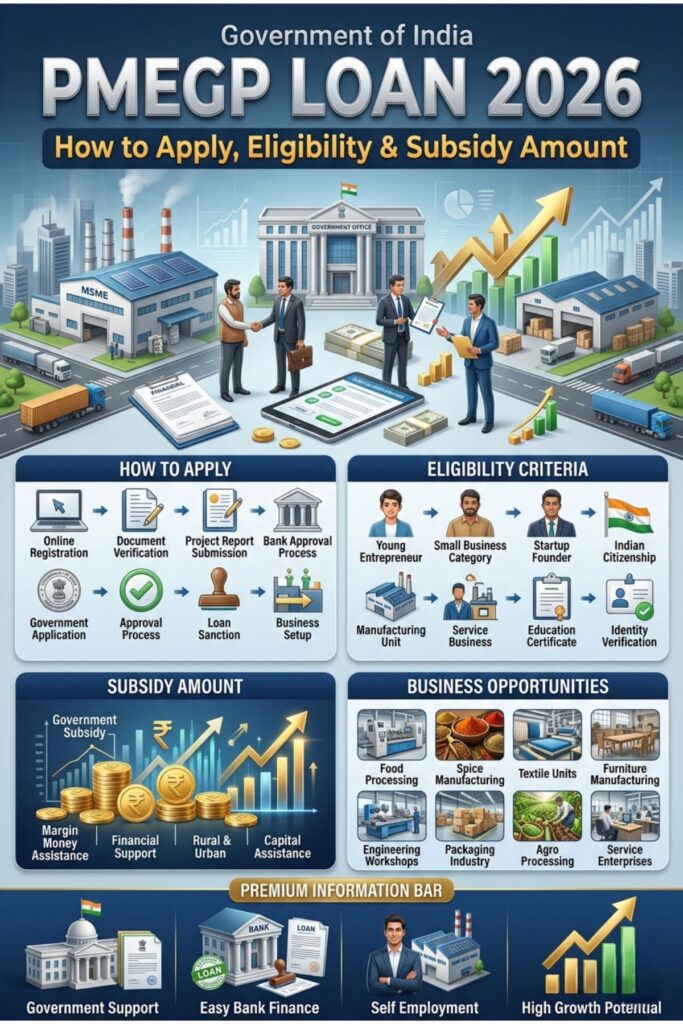
Step 1 — Check Eligibility
All the criteria are available on the KVIC PMEGP portal. Must be 18 years or older. A certificate of passing VIII standard is required for manufacturing unit if the project cost is more than ₹ 10 lakh and for service unit if the project cost is more than ₹ 5 lakh. Applicants do not need to have a specific income limit. It is not open to existing business owners, or those who have already received a subsidy under the government subsidy scheme.
Applicants eligible are Indian citizens, SHGs (Self-Help Groups), charitable trusts, cooperative societies (registered under state acts) and societies registered under the Societies Registration Act, 1860.
Step 2 — Choose Your Project and Prepare the DPR
Detailed Project Report (DPR) is the foundation of your PMEGP application. Must include product/service description, installed capacity, production plan, machinery details, cost of raw material, market analysis and a 5-year projected Profit & Loss statement. The number one reason for rejection is a poorly prepared DPR.
KVIC has a list of activities approved for projects. The manufacturing, food processing, textiles, chemicals (non-toxic), wood products, and agro-based industries are generally qualified. Non-tobacco products, intoxicants and government-banned products are not included.
Step 3 — Register on the PMEGP e-Portal
Click on kviconline.gov.in/pmegpeportal and register as an applicant on the portal. Upload all documents – Aadhaar card, PAN card, address proof, educational certificate, caste or category certificate (if applicable), project report and Udyam Registration number.
Step 4 — Application Forwarded to DIC or KVIC
Once you have submitted your application online it is sent to the nearest District Industries Centre (DIC) or KVIC District Office. A field officer will conduct a feasibility visit to your proposed project site. This phase normally requires 15–30 working days. Make sure to be available at the site visit or it will be rejected.
Step 5 — Bank Sanction and Subsidy Release
After the approval of your application by the DIC/KVIC it is submitted to the KVIC’s empanelled banks like SBI, Bank of Baroda, Canara Bank etc. most of regional cooperative banks. The bank lends the full amount of the project and issues a Term Deposit Receipt (TDR) for the subsidy amount and releases the working capital amount. You start paying back net loan (total minus subsidy). The repayment period is usually 3–7 years.
Step 6 — EDP Training (Mandatory)
The beneficiaries have to attend 2-week Entrepreneurship Development Programme (EDP) training conducted at KVIC approved training centres. This is a requirement prior to disbursement of subsidy. Bookkeeping, GST basics, marketing and operations are all areas of training.
Key Licenses and Registrations Required
- Udyam Registration is mandatory for availing MSME benefits, it is free of cost and can be completed online at udyamregistration.gov.in.
- GST Registration: If annual turnover is expected to exceed ₹40 lakh (goods) or ₹20 lakh (services)
- FSSAI License: For all food and agro-processing units. Apply via foscos.fssai.gov.in.
- Factory License / Trade License: Rewarded by the local municipal authority / State government according to the size of the unit.
- Pollution NOC: For manufacturing units, from State Pollution Control Board (Green/Orange category).
- BIS Certification: In case of certain product lines where Indian standards are applicable (Packaged Water, Electrical Goods etc.).
Table 2: Investment Breakdown for a ₹25 Lakh PMEGP Manufacturing Unit
| Cost Head | Amount (₹) | % of Total | Remarks |
| Plant & Machinery | ₹12,00,000 | 48% | Primary capex item |
| Land & Civil Works (leased space) | ₹2,50,000 | 10% | Rental deposit + fitout |
| Raw Material (3-month stock) | ₹4,00,000 | 16% | Working capital |
| Furniture, Fixtures & Tools | ₹1,50,000 | 6% | Office + production |
| Pre-operative Expenses (licenses, GST reg., Udyam) | ₹75,000 | 3% | One-time compliance cost |
| Contingency Reserve | ₹1,25,000 | 5% | 10% buffer on capex |
| Working Capital (salaries + utilities – 3 months) | ₹3,00,000 | 12% | Operating cushion |
| Total Project Cost | ₹25,00,000 | 100% | Eligible for PMEGP |
Source: NPCS Model DPR for PMEGP Category Units (niir.org) | Estimated figures based on current market rates
Financial Snapshot: What the Numbers Actually Look Like
Take a typical PMEGP manufacturing unit costing ₹25 lakh, say a small food processing unit (pickles, papad, masala or snacks) in a semi-urban area of Rajasthan or Madhya Pradesh. It is one of the most popular and most profitable categories of PMEGP.
Capital expenditure: ₹25,00,000 (Total project cost as provided in Table 2).
PMEGP Subsidy (General Category, Rural): 25% of ₹25 lakh = ₹6,25,000. This is due to your TDR and will not be paid back.
Own Contribution (10%): ₹2,50,000. Promoter pays this before the loan is sanctioned.
Bank Loan: ₹16,25,000 at approximately 9–11% per annum (varies by bank). EMI at 10% for 5 years ≈ ₹34,500/month.
MOE at 60% capacity: ₹72,000 to 90,000 (raw material, labour, electricity, packing, transport).
Monthly Revenue at 60% Capacity: ₹1,20,000 – ₹1,40,000.
Monthly Revenue at 100% Capacity: ₹1,90,000 – ₹2,20,000.
Gross Margin: 28–34% of revenue when operating at full capacity.
Net Margin (after loan servicing and all overheads): 14-20% at full capacity.
Payback Period: 3.5-4.5 years from first production, depending on the rates of capacity utilization ramp up, and local market penetration.
These are the “central estimates” for a food processing unit. The capex of a plastic moulding or packaging unit of comparable size will be higher but margins will be better (net 18-24%). A garments unit will have lower fixed costs and margins of 10-16% net.
Get Detailed Project Report (DPR): Technical Textiles Project Guide
Table 3: State-wise PMEGP Performance and Key Clusters
| State | Units Sanctioned (Annual Avg.) | Avg. Subsidy per Unit (₹) | Top Beneficiary Sectors | Key PMEGP Cluster District |
| Uttar Pradesh | 9,200+ | ₹4.8 lakh | Food processing, Textiles | Varanasi, Agra, Kanpur |
| Maharashtra | 7,500+ | ₹5.2 lakh | Engineering, Plastics, Food | Pune, Nashik, Aurangabad |
| Rajasthan | 5,800+ | ₹4.5 lakh | Handicrafts, Mining Products | Jodhpur, Jaipur, Udaipur |
| Tamil Nadu | 6,100+ | ₹5.0 lakh | Leather, Auto Components | Coimbatore, Tiruppur, Salem |
| West Bengal | 5,300+ | ₹4.3 lakh | Handloom, Jute, Chemicals | Howrah, Murshidabad, Nadia |
| Assam / NER States | 3,200+ | ₹6.1 lakh | Bamboo products, Tea, Food | Guwahati, Dimapur, Shillong |
Source: Ministry of MSME Annual Report | KVIC PMEGP Progress Report | Data compiled from msme.gov.in and kviconline.gov.in
Get Detailed Insights from This Book: Bamboo Plantation and Utilization Handbook
Entrepreneur Spotlight
Sunita Devi, Varanasi, Uttar Pradesh — Sunita is a former ASHA worker who has started her own agarbatti (incense stick) making business with a capital of ₹18 lakh through the PMEGP. She is a farmer and applied under the SC Women category and received a rural subsidy of 35% (₹6.3 lakh) and paid back her bank loan in 4 years. Today, her team has 11 women from her neighborhood and a monthly turnover of ₹1.65 lakh who supply to the wholesale distributors in eastern UP. One of her tips: “Don’t have your project report written by a generic type. Hundreds of applications are reviewed by the bank and DIC and yours should be specific, not generic.
How NPCS Can Help You Prepare a Winning PMEGP Application
An application for PMEGP is not a one afternoon job. With its a long experience of more than 45 years, Niir Project Consultancy Services (NPCS), New Delhi has assisted several thousand entrepreneurs from all over India in preparing Detailed Project Reports, Techno-economic Feasibility Reports and Plant layout Design as per the specific requirement of PMEGP-empanelled Banks and District Industries Centres. A realistic financial projection, machinery specification, raw material sourcing plan and checklist of regulatory compliance are included with NPCS reports. Model DPR templates are available at niir.org and sector-specific business guides are available at entrepreneurindia.co to help entrepreneurs access resources.
The Next Step Is Yours to Take
PMEGP is not going to you! You will not be called by the DIC office in your district. It will not be offered by the bank manager without being asked for. This scheme is for walkers with preparedness (appropriate project report, clean documentation, realistic business plan).
You are eligible if you have an original manufacturing or service concept, you are over 18, you have never been awarded a government subsidy, and can provide 5–10% of the project costs from your own resources. The subsidy is actual cash proceeding from which your debts are reduced from the very first day; it ranges from ₹3.75 lakh to ₹17.50 lakh based on your category and project size.
What you should do today: Go to kviconline.gov.in/megaportal, register as an applicant and find out your DIC office. When it comes to a project report, here is where it begins. It takes 7-10 working days to prepare by most DPR consultancies such as NPCS (niir.org). Funds are limited and the deadline for the allocation of the current financial year is almost reached, with earlier applicants being more likely to get their funding.
FAQs
Q1. What is the maximum subsidy applicable to the PMEGP scheme?
For a manufacturing project valued at 50 lakhs the maximum subsidy is 17.50 lakhs (35% of the project cost for SC/ST/Women/Minorities and rural locations) or 7.50 lakhs (15% of the project cost for the General category in urban locations). The subsidy itself is parked in a TDR and set off against your loan; you never have it in cash.
Q2. What documents are required for applying for the PMEGP scheme?
The essential documents are Aadhaar, PAN Card, proof of date of birth, qualification certificates (at least VIII passed for manufacturing units above 10 lakhs and service units above 5 lakhs), caste certificate if applicable, Udyam Registration certificate, Detailed Project Report, two passport size photos and any further KYC required by the bank.
Q3. Is the PMEGP scheme applicable for service businesses and not just manufacturing units?
Yes, service sector units can avail PMEGP with a maximum project cost of 20 lakhs. Eligible sectors for service businesses include beauty parlours, repair shops, tailor units, catering services and printing and computer related services. The subsidy rates are the same as those for manufacturing units 15-35%.
Q4. Which are the banks that provide loans under the PMEGP scheme and is collateral required?
Loans under PMEGP are provided by public sector banks (like State Bank of India, Bank of Baroda, Canara Bank and Punjab National Bank), Regional Rural Banks (RRBs) and Co-operative banks enlisted with KVIC. The loans up to 10 lakhs are collateral free under the CGTMSE scheme. Banks can also ask for a guarantor or collateral up to 25% if the project loan exceeds 10 lakhs, however, many listed banks take full cover under the CGTMSE scheme.
Q5. What are the reasons why applications for PMEGP are rejected most often?
The main reasons for rejection are a poorly prepared or unrealistic Detailed Project Report, discrepancy between stated cost of project and machine quotations, already being a beneficiary of central government subsidy, applicant owning or being the only beneficiary of a previous project (in cases where the second business is being setup by a person already having business, unless the first business is fully operational with an existing setup), a proposed project in a restricted area and the absence of proof of EDP training. Preparing the DPR with the help of an expert Consultant ensures a successful loan application.
Q6. Does NPCS specifically help with PMEGP project reports?
Yes. NPCS provides custom-prepared bank-ready detailed project reports for eligible manufacturing and service units that can be used to apply for loans under the PMEGP scheme. These detailed reports include specifications of machinery, break-even analysis, projections of revenue, machinery costs and a list of regulatory compliance documents, along with their requirements. Specific to application review, these reports are well laid out to help the DIC approve. Log on to niir.org to view available reports or visit the NPCS office in New Delhi for assistance.


