





Agro Waste Biochemical Business
Introduction: Why Agricultural Waste Is the Richest Untapped Business Idea in India
Over 500 million tonnes of agricultural residue is burnt annually in India. Rice husk. Sugarcane bagasse. Corncobs. Wheat straw. During the post-harvest season, these generate clouds above Punjab and Haryana. Unused is left in the back of sugar mills from Maharashtra to Uttar Pradesh. In the rice growing areas of Odisha, they are stored at the mills and then burnt as a low-quality fuel — thus negating their actual commercial potential. The reality is that with every tonne of rice husk burnt, there is a significant opportunity to generate specialty biochemical products such as: furfural, lactic acid, silica, and biochar, which command industrial and pharmaceutical prices of ₹80 per kilogram to ₹500 per kilogram. These aren’t business ideas for the few. They are tried and tested manufacturing groups that are commercially viable and have been the basis for a whole business by global chemical firms. India has the feedstock, the place, and policy support for this industry to be built from scratch and Odisha is a particularly promising place to do so.
Why This Sector Is at an Inflection Point
Renewable resources are becoming an attractive feedstock for biochemical production in three ways. China, which produces about 70% of the world’s furfural, is facing scrutiny for its dominance due to risk issues with the supply chain, uncertainty in trade policy, and tightening environmental regulations in China. Foreign purchasers are actively looking for other suppliers. India produces the same corncob and rice husk feedstocks as China does, in similar quantities, but hasn’t developed a competing chain.
Second, the global market for bioplastics and PLA is expanding at a rate of 15%+ per year, spurred by the new plastic ban laws and the commitments made by FMCG companies to plastics packaging. Lactic acid is the monomer of PLA. Lactic acid is produced by the fermentation of agricultural sugar (broken rice, corn starch, cassava) which is readily available in India. Third, succinic acid and lactic acid are both EU designated priority bio-based platform chemicals under the EU Green Chemistry framework, giving the EU a regulatory-pull export demand, which conventional petrochemical acids cannot address.
Source: Invest India – Chemicals Sector
Get Detailed Insights from This Book: The Complete Book on Biomass Based Products (Biochemicals, Biofuels, Activated Carbon)
Government Policies Supporting Biochemical Manufacturing
The Department of Biotechnology’s BIRAC (Biotechnology Industry Research Assistance Council) scheme offers grants and equity support to biochemical ventures that rely on fermentation technology, as well as biorefinery pilots. The capital subsidy for agro-processing units that process agricultural waste into value added products is provided under technology upgradation schemes of the MSME Ministry. The National Bioeconomy Strategy clearly marks out bio-based chemicals made from agri-residues as a strategic priority sector for India.
The biochemical manufacturing units that use rice husk or sugarcane bagasse as raw material in Odisha are considered as agro-processing industries and are eligible for the capital subsidy of 15–25% on the investment, electricity duty waiver for 5 years and exemption of stamp duty. Importantly, agro processing projects usually qualify for B2 environmental clearance, which is a much lighter course than that for the conventional chemical manufacturing. This not only shortens the project schedule, but costs for compliance are also significantly decreased. Single window clearances are available in Odisha SLSWCA.
Source: Invest Odisha – Official Portal
Biochemical Business Ideas from Odisha’s Agricultural Waste
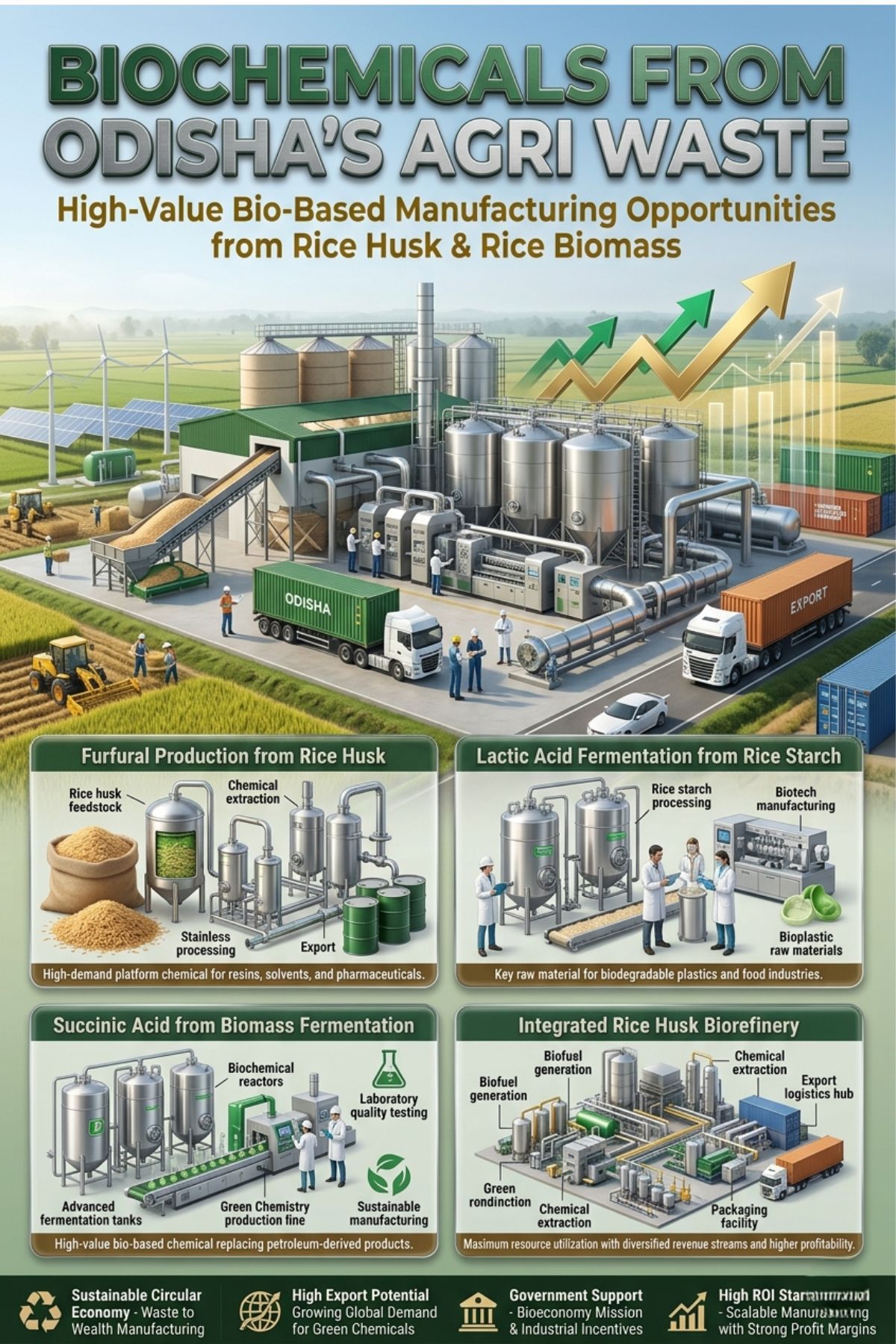
Business Idea 1: Furfural Production from Rice Husk
The hemicellulose fraction of agricultural residues is the main source of furfural; it is present in rice husk in the form of xylose (15–20% of the dry weight). Acid hydrolysis of hemicellulose fraction, dehydration, distillation and purification are steps in the production process. The resultant furfural is an aromatic aldehyde that is colourless to amber and has an unusually wide variety of applications downstream e.g. as a component in bio fuels, furfuryl alcohol (foundry resins for metal casting) and tetrahydrofurfuryl alcohol (specialty green solvent). The production of paddy in Odisha is around 7–8 million tonnes per year, out of which 1.5–2 million tonnes of rice husk is burned or utilized for lower grade fuel. The cost of furfural produced from 20,000–50,000 TPA rice husk processing plant is ₹ 80 – 150 per kg in industrial grade and ₹ 200 – 400 per kg in specialty & pharmaceutical grade. Capital requirement: ₹25–80 crore. Gross margins: 35–55%. The world’s furfural supply is led by China. Direct export potential, this is an import substitution play.
Related Article: Bio-Based Chemical Business Idea: Furfural Plant Cost, Profit and Market Demand in India
Business Idea 2: Lactic Acid Fermentation from Rice Starch
Lactic acid is a product of microbial sugar fermentation with Lactobacillus strains. The feedstock (glucose from starch hydrolysis) can be obtained from broken rice, corn starch and cassava. The broken rice from the rice mills of Odisha is now being sold at the price of ₹8 – 15 per kg for use as animal feed or as feedstock for ethanol industry. The same grade of feedstock gives ₹60 to 120 per kg of lactic acid. When it is used in medicinal IV infusion solutions, its value increases to ₹300–600 per kilogram. The converted value is now further converted to PLA bioplastic polymer, with the value now at ₹150–300 per kilogram of polymer, which is premium positioning in the expanding compostable packaging sector, growing at 25-30% annually. The capital cost of a lactic acid fermentation plant is ₹30–80 crore in the range of 3,000–10,000 TPA. Can provide domestic pharmaceutical manufacturers, personal care companies and — on a larger scale — serve as a feedstock supplier for PLA production. The downstream optionality of lactic acid (from pharma excipient to green solvent to bioplastic) is one of the most promising biochemical investment options for a startup entrepreneur.
Business Idea 3: Succinic Acid from Biomass Fermentation
Succinic acid is a four-carbon dicarboxylic acid which is produced in India essentially from maleic anhydride with hydrogenation from petroleum. Produced via fermentation of sugars by Actinobacillus succinogenes or engineered E. coli, bio-succinic acid is chemically identical but comes with a certified bio-based origin, with a 20-40% price premium in export markets. It is used in commercial applications such as production of biodegradable plastics (polybutylene succinate, PBS), 1,4-butanediol (BDO) for spandex and polyurethanes production, pharmaceutical excipients and food acidulants. The US Department of Energy has named succinic acid as being among the top 12 highest-value chemicals that can be produced from biomass. Presently, the majority of succinic acid requirements are met from imports in India. An Odisha based bio-succinic acid plant of 2,000-5,000 TPA with broken rice or corn starch as fermentation feed stock will need capital investments ranging from ₹25-70 crore, and can offer selling prices of ₹150-350 per kg of the industrial grade and substantially higher prices for pharmaceutical grade.
Business Idea 4: Integrated Rice Husk Biorefinery — Multi-Product Model
The most capital efficient process to biochemical production from rice husk is the integrated biorefinery concept in which a single feedstock stream is used for multiple co-products. The products of a rice-husk biorefinery could include: furfural from the hemicellulose fraction; glucose syrup and lactic acid from the cellulose fraction; precipitated silica from the silica fraction of the rice-husk (which is used in rubber, animal feed, and dental products); and biochar from the lignin residue (which is used as a soil amendment and a product of carbon sequestration). Each product stream is a standalone revenue stream. The capital investment for biomass pretreatment and feedstock handling can be spread over all products, and this is a significant improvement on the overall economics of the project compared to a single product plant. A medium-size (30k–80k) integrated biorefinery, with a feedstock capacity of 30–80 kTPA, will cost about ₹80–200 crore and generate multiple revenue streams and a blended margin of 35–50%.
Get Detailed Project Report (DPR): Complete Guide to Rice Husk & Rice Husk Ash Projects
Import–Export Opportunity Analysis
Currently India imports furfural, Bio-succinic Acid and pharmaceutical grade lactic acid from China and European manufacturers. The import substitutions in these three categories alone add up to hundreds of millions of dollars each year. This is a domestic supplier that can provide specialty furfural derivatives or pharmaceutical grade lactic acid that can replace expensive imports and develop a local supply chain that is preferred by downstream manufacturers for supply security.
European markets are the top dollar destination on exports. EU chemical regulations specially promote bio-platform chemicals of certified origin. Furfural derivatives can be used in eco-friendly solvent formulations and meet the criteria of EU Ecolabel schemes. Bio-succinic acid products and/or products based on PLA from India will be able to avail import facilitation as per REACH registration framework in EU. The shipping connectivity to Europe through Indian Ocean route makes Odisha based biochemical exporters freight competitive to the European markets.
Source: IBEF – Indian Chemicals Industry
Indian MSME Leaders in Biochemicals and Agri-Based Chemicals
Godavari Biorefineries — Sugarcane-Based Biochemical Pioneer
Godavari Biorefineries is a success story of the Somaiya Group, being one of the most successful agri-based biorefinery businesses in India producing ethanol, bio-based chemicals and specialty intermediates from sugarcane. The company’s business model (full use of feedstock, multiple product generation, export orientation) is directly replicable in an Odisha based rice husk or bagasse biorefinery. The lesson is a biorefinery that converts a single agricultural commodity into several valuable products has a more stable business model than a one-product chemical plant, where price fluctuations in one product are offset by sales of co-products.
Praj Industries — Biorefinery Technology and Biochemicals
Pramod Chaudhari is the founder of Praj Industries, a world leader in biorefinery technology and engineering based out of Pune. Praj has designed and commissioned fermentation and distillation plants in India and abroad including many which convert agri-residue feedstocks to lactic acid, ethanol and specialty biochemicals. For an entrepreneur with a plant for lactic acid or furfural production in Odisha, Praj may also be a technology partner to look for (plant design and engineering) and an example of how biochemical technology expertise can turn into a business.
EM Biotech — MSME Biochemical Fermentation Startup
It is worth noting that lactic acid and specialty biochemicals production is commercially viable in the range of 500-3000TPA scale for EM Biotech and other startups in the MSME segment in India without the benefit of scale advantage that is provided to large chemical companies. They have a model that emphasizes product quality, and they have direct customer engagement with personal care and pharmaceutical buyers, as well as a continuous process improvement process. The answer is these MSMEs, for a first-generation entrepreneur in Odisha that the biochemical fermentation business does not need a ₹200 crore plant to make real commercial returns.
How NPCS Supports Your Biochemical Project
Niir Project Consultancy Services (NPCS) prepares comprehensive Techno-Economic Feasibility Reports for entrepreneurs who are considering a furfural plant, a lactic acid fermentation unit, a succinic acid biorefineries and integrated multi-product biorefinery models. Our reports provide thorough descriptions of the process technology, raw material analysis – including agri-residues sourcing and cost, machinery selection and detail of supplier, complete project cost estimation, market demand analysis with identification of buyers and schedules showing complete financial modelling – including revenue projections, breakeven analysis, loan repayment schedules and so on. If you are a first-generation entrepreneur, you are contemplating investing in a ₹25 crore furfural plant, or if you are an investor in the industrial segment, you are looking at a ₹150 crore integrated biorefinery, our DPR provides you with clarity to move forward with confidence.
Source: NPCS – Project Reports
Choose the right startup backed by real market demand
Biochemical Products from Agri Waste — Opportunity Data Table
| Biochemical | Feedstock in Odisha | Price/kg (₹) | Capital (₹ Cr) | Primary Market |
| Furfural | Rice Husk | 80–400 | 25–80 | Resins / Solvents / Export |
| Lactic Acid | Broken Rice / Corn | 60–600 | 30–80 | Pharma / PLA / Cosmetics |
| Bio-Succinic Acid | Rice / Corn Starch | 150–350 | 25–70 | PBS Bioplastics / Pharma |
| Furfuryl Alcohol | Furfural (downstream) | 120–250 | 15–40 | Foundry Resins |
| Precipitated Silica | Rice Husk (co-product) | 40–120 | 10–25 | Rubber / Animal Feed |
Frequently Asked Questions (FAQ)
1. What is the minimum viable scale for a furfural plant in Odisha?
Commercial furfural production becomes viable at 500-1,000 TPA product output, which requires a 5,000-10,000 TPA input of rice husk. Below this level, fixed costs result in unattractive unit economics. The sweet spot for an MSME, first generation project is 1,000-3,000 TPA; capital requirement is in the 25-50 crore range and can produce profitable levels at present prices for furfural.
2. Is lactic acid fermentation technology available in India?
Yes. Several Indian engineering firms and fermentation tech providers, such as Praj Industries, have designed and commissioned lactic acid plants in India. The fermentation technology is mature and well understood. A key factor for success is selection of a suitable microbial strain for the feedstock, optimization of fermentation parameters and design of a robust downstream purification chain for pharmaceutical-grade products.
3. How would a rice husk furfural plant in Odisha compete with imports from China?
Chinese imports are price competitive based purely on the scale advantages in manufacturing. Indian producers are helped by: zero duty on domestic sales, no exchange risk, shorter lead times and supply chain proximity. Indian manufacturers can now benefit from buyers moving their supply chain away from China, both in India and Southeast Asia, specifically for niche chemical intermediates for pharmaceuticals, personal care, etc. The focus of an Indian furfural plant should not be the commoditized segment to compete with China.
4. What are the environmental clearances required for a rice husk biorefinery in Odisha?
A rice husk processing unit will be categorised as agro-processing industry and therefore likely subject to B2 clearance from the EIA Notification which means it would have to clear the state-level environmental clearance process which has a relatively shorter time-frame as opposed to the full EIA. For Odisha’s single-window clearance (SLSWCA), this clearance would come along with other state-level clearances. Consent-based clearance can be obtained without a full EIA if production is below 50 TPA product output.
5. Can a succinic acid plant be established with limited initial investment?
Yes. An initial pilot-to-commercial plant at 500-1,000 TPA bio-succinic acid would cost in the region of 20-35 crore; these sizes would focus on the premium priced applications: pharmaceuticals and food ingredients. The natural progression will be to scale the operation to 1,000-5,000 TPA while the first three to four years focus on building customer relationships and quality credentials.
6. Are there any government grants available specifically for biochemical startups based on agro-waste?
Yes. The Biotechnology Industry Research Assistance Council (BIRAC) under the Department of Biotechnology, provides grants and equity funding for the biotech based biochemical ventures and Ministry of MSME’s ASPIRE scheme for incubators & startups in agro processing industry. Further, Odisha’s MSME policy offers capital subsidies which make this sector one of the most incentives-driven chemical manufacturing segment in India.
Conclusion: Odisha’s Agricultural Waste Is a Chemical Manufacturing Resource
Each tonne of rice husk burnt today in Odisha is a lost opportunity to produce one of the following which are in demand with industrial buyers in India, Europe and Southeast Asia and fetch premium prices: furfural, lactic acid, silica or biochar. The technology used for the conversion is proven. Copious feedstock is available. The market is growing. The government’s support is in place. What is needed is an entrepreneur who knows that agricultural waste products are not a waste problem, but a raw material problem waiting for the right manufacturing solution.
Hence, biochemical opportunity for Odisha is not a long-term forecast. It is a present-tense investment opportunity that can be capitalized by first movers before there’s a lot of competition in the sector. Furthermore, the multi-product biorefinery approach translates into the ability to achieve multiple revenues from a medium-sized investment in this area, making the operations more resilient than a single product plant. The entrepreneurs who will be working to develop the biochemical industry from the rice husk and agricultural biomass will not only earn profit from it. They will purify the environment, generate rural jobs and provide the first serious chemical cluster in the specialty chemicals sector in bio-based chemicals in India.


