





Rural Manufacturing Business Ideas
Rural India is no longer just a supply base for raw material. That’s happening to become a real manufacturing hotspot and there are real business ideas there for those who can invest a little at a time. A first-generation entrepreneur in a district town today has access to power, transport, credit and digital markets that are better than in the last 20 years. This article examines the opportunity, policies supporting it, and specific businesses that would make sense for someone starting with limited capital resources in a village or small-town setting.
It is a logic that is easy to understand. Raw material is nearer to the source in rural belts; the labour is cheaper than in metro clusters and in the years since the government has actively encouraged manufacturing to move away from overcrowded cities. All three factors combine to alter the economics of small manufacturing. But opportunity is not a business, though. Within the first three years, a rural unit is either successful or unsuccessful based on execution, market access, and financial planning.
Why Rural Manufacturing Deserves Serious Attention Now
Village-level manufacturing is not the same as it used to be; it’s no longer the low-margin, subsistence making of things. There are several factors at play, and they all make for a compelling argument to begin a unit outside the major cities.
Lower Input Costs Change the Profitability Equation
The cost of land, labour and sometimes electricity is much lower in the rural clusters compared to industrial belts in metros areas. A small chemical formulation plant or a food processing unit can be established in the village with a small fraction of the capital cost of a similar plant in the industrial estate. Thereby, break-even quantities decline and a relatively small unit can become profitable within the first 2-3 years of its operation.
Raw Material Proximity Reduces Logistics Risk
The location of the Agro-processing, dairy, bamboo and mineral based units are directly advantageous. If unit processes produce in a short radius from the farm/mine, it means that there is a reduced transport cost and a low risk of spoilage. For instance, a fruit-pulp or millet processing unit can be set up on the growing belt and source fresh produce, rather than having to pay for long haul cold chain transportation from a far-off mandi.
Export and E-Commerce Have Opened New Sales Channels
The rural producers earlier were relying on the local mandi and some traders. That reliance is now lessened. Support from government for exports, e-commerce platforms and GeM (Government e-Marketplace) procurement now enable a small manufacturer to successfully sell across states and even overseas without maintaining a big sales team. More and more handmade products, food items, light engineering goods from rural clusters are being sold in the Middle East, Europe and South-East Asian countries by export promotion councils and B2B marketplaces.
Government Push for Decentralised Industry
The journey from Make in India to the PLI schemes has always been in favour of decentralizing manufacturing. States lure investment to the rural areas by offering capital subsidy, waiver of stamp duty and interest subsidy. This is not a short-term phenomenon; it is a structural priority to harmonize the development of regions and decrease migration pressure on cities.
Government Policies and Incentives Supporting Rural Manufacturing Business Ideas
Of course, no rural manufacturing plan will be complete without mapping out the schemes that mitigate the initial investment risk. There are a number of central and state-based schemes, which are specifically geared towards village units and small towns.
Prime Minister’s Employment Generation Programme (PMEGP)
For a first-time rural manufacturer, PMEGP, under the Ministry of MSME and implemented by Khadi and Village Industries Commission, is the most relevant scheme. It provides subsidy of 15 percent to 35 percent of the project cost, depending on the category of the applicant, and the location of the project, for manufacturing projects, support of up to ₹50 lakh. The higher subsidy slab is given to the rural and women or special category applicants, which significantly reduces the promoter’s contribution.
PM Formalisation of Micro Food Processing Enterprises (PM FME) Scheme
If you are interested in entering the food processing industry, whether pickles, spices, millet products, fruit pulp or something related to dairy, the PM FME scheme is available by MoFPI wherein they will provide you credit linked capital subsidy with maximum of 35% of the project cost and will provide support for common infrastructure development, branding and FSSAI compliance. This scheme is particularly targeted at unorganised, rural, home based and cluster-based food units, making them a perfect fit for village level food manufacture.
Production Linked Incentive (PLI) and Make in India Support
The flagship PLI schemes are targeted at larger manufacturers, but have a significant indirect impact on the rural entrepreneur. While the anchor companies grow under PLI in areas such as food processing, textiles, and electronics, the demand for ancillary services such as packaging, components and semi-processed input from small rural companies also increases. A rural unit that markets itself as a vendor to an anchor plant that is tied to a PLI program will probably be able to get orders that are more regular and larger in price than if it is just targeting the open market.
MSME Credit and Collateral-Free Loan Support
One of the major constraints for rural promoters who do not have any property to pledge is addressed through the credit guarantee framework of the Ministry of MSME which provides for collateral free loan of up to ₹2 crore to eligible micro and small units. Together with the priority-sector lending norms that push banks to lend to MSME, this framework has a meaningful impact on increasing loan approval rates of a well-prepared rural project.
State-Level Industrial and Rural Investment Schemes
Almost all states have their own tier of incentives above the Federal level. The government’s One District One Product (ODOP) initiative supports manufacturing clusters in each district through a host of initiatives, including credit line subsidies and marketing assistance. In the industrial promotion policy, the government of Maharashtra gives interest subsidy and capital subsidy to units in less developed talukas. The rural industrialisation scheme is similar to that of Odisha, Madhya Pradesh and Rajasthan, which are run by their industries departments. Always review the state industries department’s portal in addition to central schemes; a rural entrepreneur can reduce the promoter contribution by half or less if he/she receives the state subsidy on top of the central subsidy.
Skill Development and Rural Self-Employment Training
NRLM and Rural Self Employment Training Institutes (RSETIs) provide a short duration and free trainings to the rural entrepreneurs before applying for loans. RSETI training completion is seen as a positive indicator in the appraisal of a bank loan as it indicates that the applicant has gone through a structured form of business planning.
Multiple Business Ideas for Rural and Village-Level Manufacturing
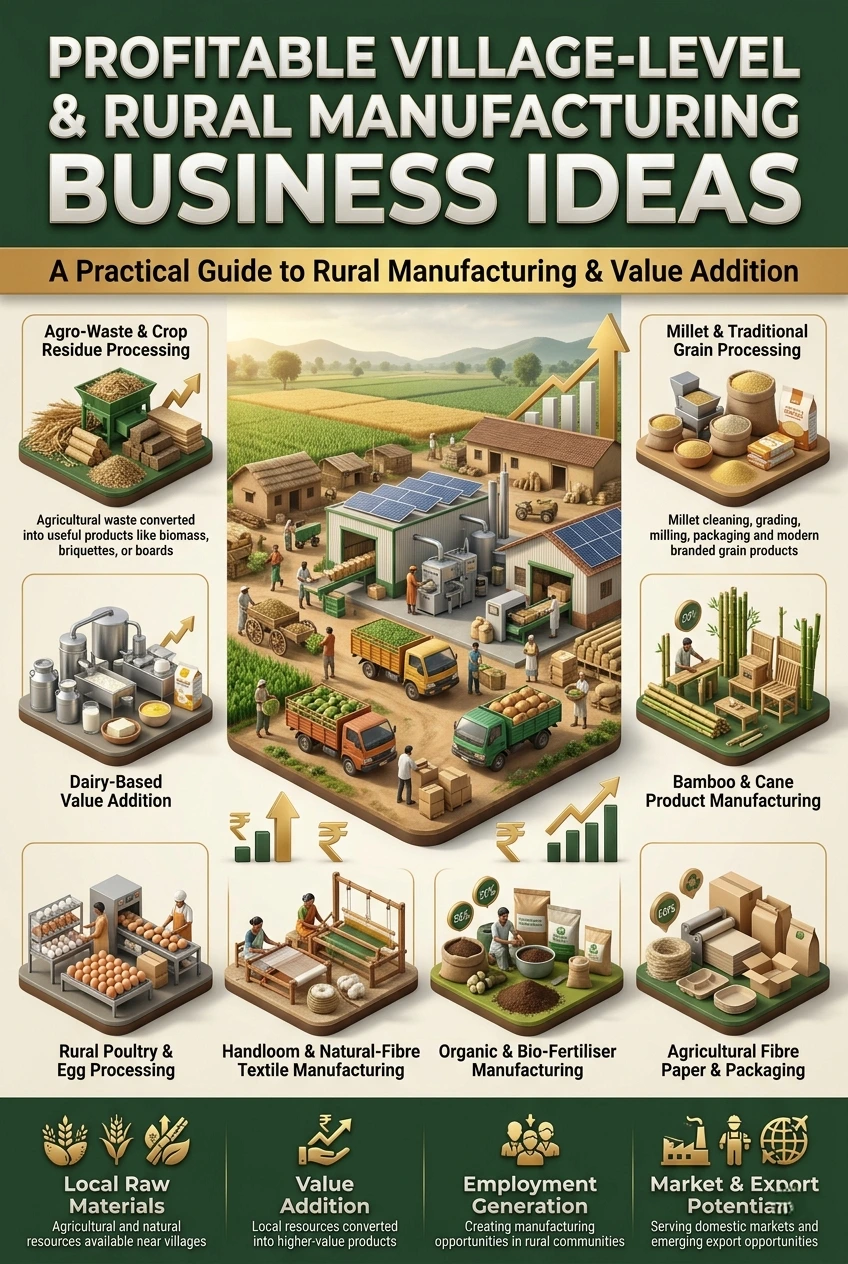
The ideas below are appropriate to various investment levels, but all rely on an actual rural opportunity: local raw material, lower overheads or an unmet local need.
Agro-Waste and Crop Residue Processing
Farmers burn or dump high quantities of crop residue in the most of the villages and that waste stream is a costless raw material for an entrepreneur to invest basic processing facilities. Paddy straw and sugarcane bagasse can be processed to make biomass briquette, packaging board or particle board for furniture.Paddy straw and sugarcane bagasse can be processed into biomass briquette, packaging board or particle board to use for furniture. A small capacity unit will require a shredder, a briquetting machine and drying area and the overall machinery investment will be in the range of Rs 15 lakh to Rs 25 lakh.
There is demand from local brick kilns, boilers and food processing industries which are increasingly shifting from coal to biomass fuel due to the cost and emission norms. The gross margin of briquetting businesses is rarely as high as most other rural manufacturing categories, as the raw material is basically free at the farm gate, and the entrepreneur has to make a good offtake contract before scaling the production of the briquettes.
Get Detailed Insights from This Book: Products From Waste (Industrial & Agro Waste)
Millet and Traditional Grain Processing Unit
The renewed efforts in millets in India, with both the interest of the central procurement and promotion of its export, have led to new demand for processed millet products such as flour, flakes and ready-to-cook mixes. The base processing line can be initiated with equipment for cleaning, dehulling and milling for as low as ₹20 lakh at the village level and can be scaled up to value added products such as millet cookies or instant mixes after establishing the base processing line.
A local unit has a true sourcing advantage over its urban counterparts because of the way the millets are grown in rain-fed and semi-arid conditions with fewer processors operating in the region. In the retail sector, as opposed to commodity processing, the importance of branding is greater; the final consumer of millet products is willing to pay a premium price to these products because they are sold under the umbrella of health and tradition.
Dairy-Based Value Addition (Ghee, Paneer, and Flavoured Milk)
Villages that have some current dairy production seldom maximise the returns from their milk sales as the majority of milk is sold as raw liquid milk at a price that varies seasonally. A small dairy processing unit for ghee, paneer or flavoured milk in pouches can be created to turn the same milk into product(s) that have two to three times the realisation, for a rural entrepreneur. The equipment for a small-scale plant (with a pasteuriser, chiller and packaging line) ranges from ₹18 Lakhs to ₹30 Lakhs.
The two operational aspects that warrant attention are licensing by the FSSAI and cold-chain logistics in the last mile; the quality of dairy products is quickly passed on by word of mouth in a local market. However, after establishing the basic hygiene and packaging systems, dairy value addition is more likely to generate loyal repeat demand than most other food sectors.
Explore This Book: Modern Technology Of Milk Processing & Dairy Products
Bamboo and Cane-Based Product Manufacturing
Bamboo is cultivated in large quantities in the northeastern region, in parts of West Bengal, Odisha and Madhya Pradesh and is one of the least processed raw materials in the rural areas of India. This is one of the lowest-cost units on the list as it requires hand tools, semi-mechanised tools, and can begin with an investment of ₹8 lakh to ₹12 lakh for a bamboo furniture, mat or incense sticks production unit or another packaging unit using bamboo.
The Government support here is very high, as bamboo is not subject to forest-produce restrictions because it was reclassified as a grass rather than timber, and the laws which regulate harvesting and transport are simplified. This category has a growth trajectory beyond the domestic market, in addition to the domestic market, it sees potential in export markets, especially from buyers who wish to replace plastic packaging with bamboo packaging.
View Full Project Details: Cane & Bamboo Handicraft Manufacturing Project Report
Rural Poultry and Egg Processing
A rural unit can progress from live-bird and egg sales to value-added poultry products such as marinated cuts, processed eggs or ready-to-cook poultry products which can be sold to neighbouring towns and institutional buyers such as hostels and hospitals. The investment in a basic processing and cold-store is estimated to be at about ₹20 lakh to ₹35 lakh depending on the storage capacity, which brings in the advantage with the basic poultry farming entrepreneur in control of the raw material supply chain.
Institutional buyers have a preference for consistency and hygiene certification over price and therefore a unit that invests in the right cold-chain and FSSAI certification is likely to secure longer term supply contracts as opposed to one-off orders.
Access Complete Business Plan: Poultry Egg Farming Business: Project Report & Business Plan
Handloom and Natural-Fibre Textile Manufacturing
Handloom clusters are in operation in several states, with those in Odisha, Andhra Pradesh, Tamil Nadu and Assam having a high demand for their textiles both in the domestic premium retail market as well as in the export sector. To have a small unit with four to six looms up and dyeing and finishing arrangement can be made for approximately ₹10 lakh to ₹18 lakh.
In this category the larger limitation is not usually capital, but rather the ability to gain access to the market, as the individual weavers may not have access to a brand or means of distribution to sell to the markets, at a fair price. An entrepreneur with production activity and direct connections to e-commerce or export house deals is able to be able to achieve higher margins than one with middlemen.
Check Out This Recommended Book: The Complete Technology Book on Textile Spinning, Weaving, Finishing and Printing
Organic and Bio-Fertiliser Manufacturing
The increasing input prices of chemical fertiliser and increasing farmer interest in soil health are leading to a consistent demand for organic manure, vermi-compost and bio-fertiliser locally. An investment of ₹8 lakhs to ₹15 lakhs is required in the rural unit for the purchase of pits, shredding machine and packaging material, using the farm waste, cattle dung and biodegradable residue as feed-stocks.
The distribution remains easy as the target customers are local farmers and transport costs are low as compared to food and textile categories that require long distance transport. This is one of the few manufacturing concepts in the rural areas which directly improve the surrounding agricultural economy, which further improves the entrepreneur’s other input supply relations in the village.
Related Article: How and Why to Start a Microbial Inoculants Manufacturing Business
Paper and Packaging from Agricultural Fibre
Demand for biodegradable packaging is rising quickly as urban retailers and food-delivery platforms move away from plastic. Agricultural fibre — from banana stem, sugarcane bagasse, or wheat straw — can be converted into disposable plates, cups, and packaging sheets using semi-automatic moulding machines that cost roughly ₹12 lakh to ₹22 lakh for a modest production line. Rural units enjoy a genuine cost edge here because fibre transport distances stay short, and labour-intensive finishing work suits the local workforce. Institutional catering, event businesses, and quick-service restaurants in nearby towns form a ready, growing buyer base for this category.
Get Detailed Project Report (DPR): Paper Industry & Paper Products Manufacturing
Import–Export Opportunity Analysis for Rural Manufacturing Startups
Export potential in rural manufacturing is stronger than most first-time entrepreneurs assume, largely because global buyers are actively looking for sustainable, handmade, and agro-based products — categories where rural India has a natural edge.
Bamboo and natural-fibre products, organic food items, and handloom textiles see consistent overseas demand, particularly from buyers in Europe, the Middle East, and North America who are shifting away from plastic packaging and synthetic textiles. The Export Promotion Council for handicrafts and allied sectors actively supports small manufacturers with buyer-seller meets, trade fair participation subsidies, and market intelligence, which lowers the cost of finding a first export buyer.
On the import side, rural units rarely need to import raw material, since most rural manufacturing ideas deliberately use locally available inputs. However, some categories — such as processing equipment for dairy or food processing — often involve imported components, particularly for automation-heavy lines. Entrepreneurs sourcing such machinery should check whether it qualifies for concessional import duty under MSME technology upgradation schemes, since equipment cost is usually the single largest fixed-cost item in a rural manufacturing project.
Export documentation and compliance remain the biggest practical hurdle for a first-time rural exporter. Registering for an Import Export Code through DGFT, understanding FSSAI export certification for food products, and meeting destination-country labelling norms take real time. Entrepreneurs who plan for this compliance timeline early, rather than treating it as a final step before shipping, avoid the costly delays that often derail a first export order.
Indian MSME Success Stories Worth Studying
Real examples make the opportunity concrete, and India has no shortage of rural or small-town manufacturers who scaled from modest beginnings into substantial businesses.
Lijjat Papad, started by seven women in Mumbai with a borrowed sum of ₹80, grew into a nationwide cooperative with thousands of women members across production centres, many of them in small towns and semi-urban locations. The founders’ decision logic was straightforward: keep quality consistent across decentralised production units, and let the cooperative structure — rather than a single owner — drive growth and profit-sharing. The lesson for new entrepreneurs is that a simple product, made consistently well and distributed through a trusted network, can outcompete larger organised players over time.
Amul, though now a giant, began as a small cooperative dairy movement in Anand, Gujarat, built around the same rural value-addition logic described earlier in this article: convert raw milk into higher-value processed products and cut out exploitative middlemen. Verghese Kurien’s core decision — building farmer-owned cooperatives rather than corporate-owned processing plants — created a model that thousands of rural entrepreneurs still draw on today when they set up cooperative or cluster-based processing units.
Vasudha Foundation and similar rural agro-processing enterprises in states like Rajasthan and Madhya Pradesh show a more recent pattern: a small founding team identifies one underused local crop or byproduct, builds a basic processing line, and grows through direct partnerships with retail chains rather than traditional mandi channels. Their approach demonstrates that a rural manufacturer does not need a large marketing budget to reach urban consumers, provided the product quality and packaging meet organised retail standards from the start.
The common thread across these examples is patience with scale. None of them jumped straight to large capacity. Each one proved the model at a small, manageable size first, then expanded once demand and operational discipline were both established.
How NPCS Supports Rural Manufacturing Business Ideas
Turning any of these business ideas into a bankable project takes more than enthusiasm. We at Niir Project Consultancy Services (NPCS) provide professional consulting for the preparation of Market Survey cum Detailed Techno-Economic Feasibility Reports (DPRs) for setting up new industries or businesses. Our reports include detailed manufacturing processes, market research and demand analysis, process flow diagrams, product mix and capacity planning, machinery and raw material details, and complete project financials with profitability analysis.
For a rural entrepreneur applying under PMEGP, PM FME, or a state industrial scheme, a properly structured DPR is often the deciding factor in loan approval, since it gives the bank a clear, verifiable basis to assess project viability. Our objective is to help entrepreneurs evaluate feasibility, profitability, and long-term scalability before investing, so that capital goes into a business idea that has been stress-tested on paper before it is tested in the market.
Discover scalable startups tailored to your goals
Rural Manufacturing Business Ideas: Indicative Investment and Return Snapshot
| Business Idea | Approximate Investment | Typical Employment Generated | Primary Government Support |
| Agro-waste briquetting unit | ₹15–25 lakh | 8–12 workers | PMEGP, state industrial subsidy |
| Millet processing unit | ₹15–20 lakh | 6–10 workers | PM FME, PMEGP |
| Dairy value-addition unit | ₹18–30 lakh | 10–15 workers | PM FME, NABARD dairy schemes |
| Bamboo product manufacturing | ₹8–12 lakh | 6–10 workers | PMEGP, bamboo mission support |
| Poultry processing unit | ₹20–35 lakh | 8–12 workers | PMEGP, MSME credit guarantee |
| Handloom textile unit | ₹10–18 lakh | 6–10 workers | PMEGP, handloom cluster schemes |
| Organic fertiliser unit | ₹8–15 lakh | 5–8 workers | PMEGP, state agri-subsidy |
| Agro-fibre packaging unit | ₹12–22 lakh | 8–12 workers | PMEGP, plastic-alternative incentives |
Figures are indicative and depend on capacity, location, and machinery choice. A detailed project report adjusts these numbers to the entrepreneur’s specific scale and site.
The Bottom Line
Rural manufacturing has moved from a policy talking point to a genuinely workable business path, backed by real subsidy money, real market demand, and real success stories to learn from. The entrepreneurs who succeed in this space rarely start with the biggest capacity or the most capital. They start with one product, one local advantage, and a realistic financial plan, and they let the business earn its way to scale. For anyone serious about acting on these business ideas, the next step is straightforward: pick one opportunity that matches your local raw material and skill base, get a proper feasibility study done, and apply for the scheme that fits your project size before committing capital.


