





EV Component Manufacturing Business in India
The Number That Changes Everything
Ninety-four percent. This is India’s reliance on imports for sophisticated power electronics that power EVs such as motor controllers, on-board chargers, and battery management systems. The brain of an electric 2-wheeler that rolls out of any Pune factory, is almost surely Chinese or Taiwanese. The final assembly is done in India. The value is not.
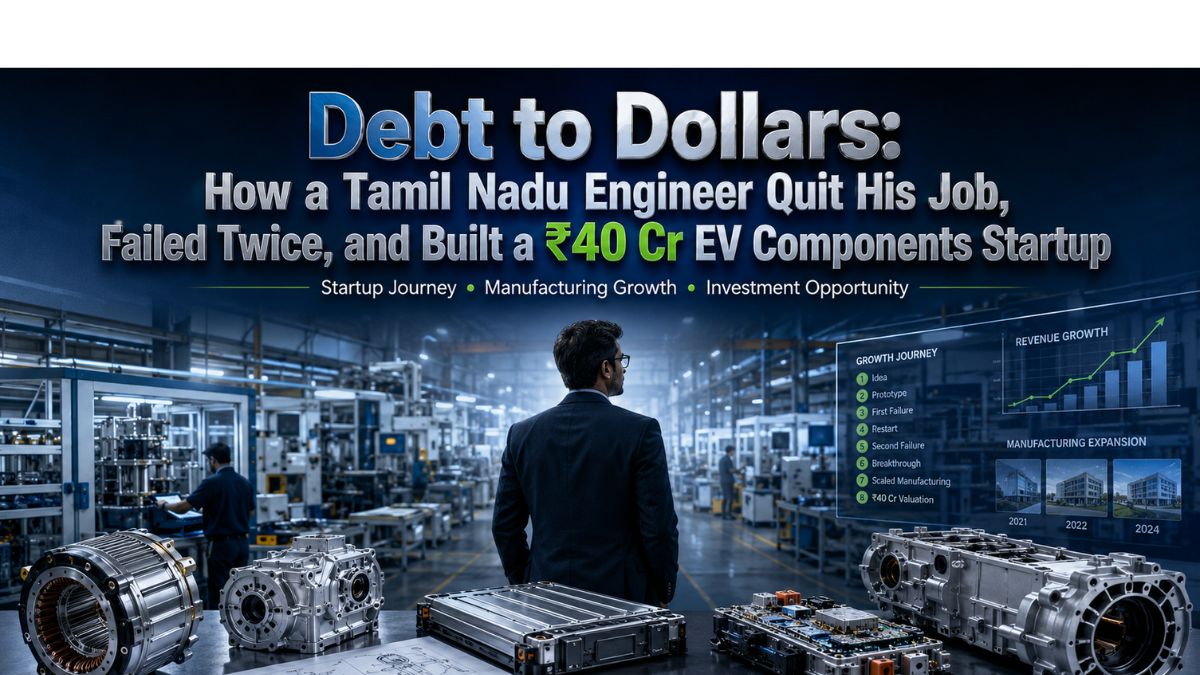
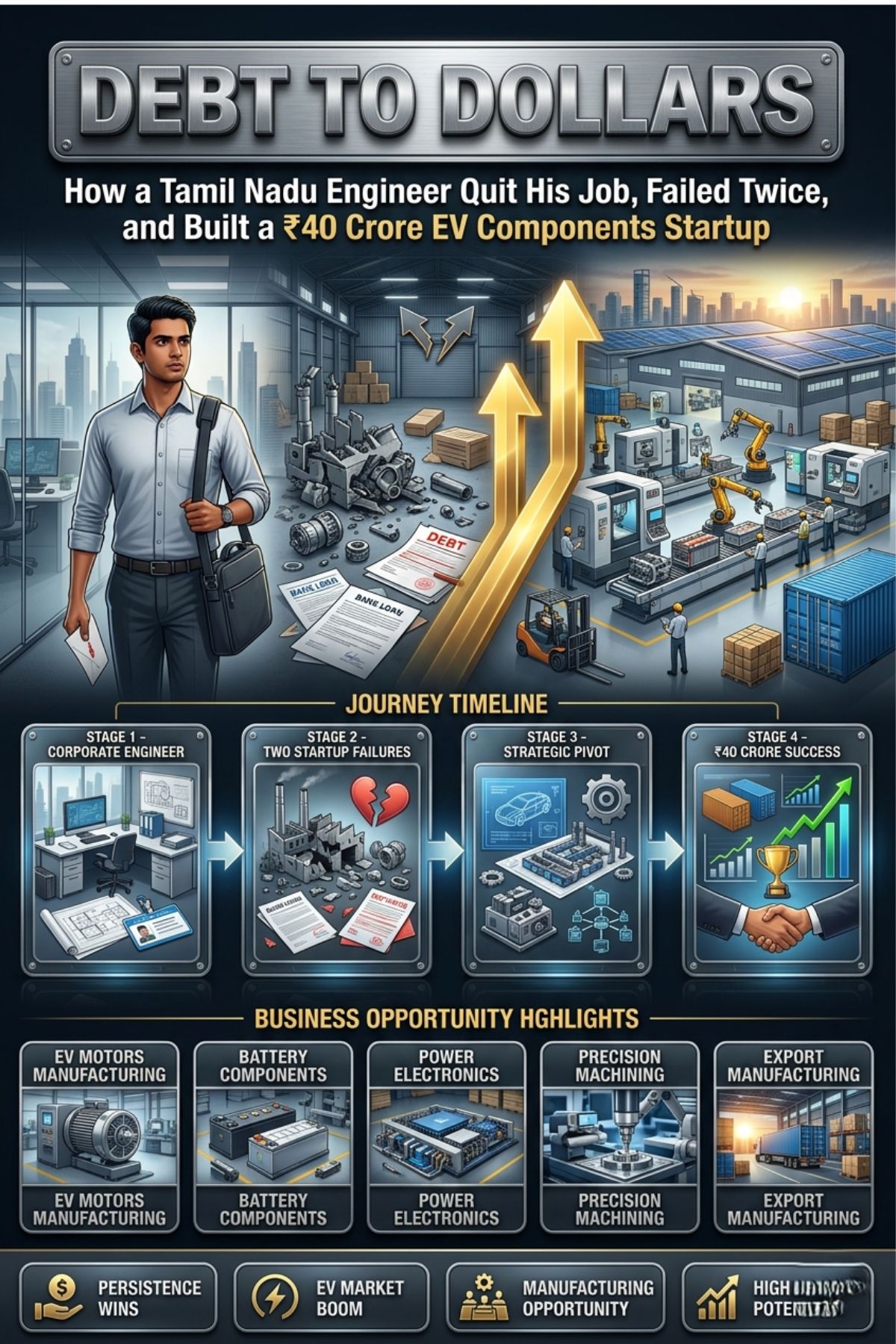
This number was known to Aravind Krishnamurthy before the EV boom became a reality for most others. He is a power electronics engineer from Tiruchirapalli, who worked for nine years with a Tier 1 auto ancillary company near Chennai, observing what happens as components are shipped through the supply chain — and every single time, the boxes with Chinese labels. He left his position of earning ₹18 lakh per year, and tried his luck with two start-ups before setting up an EV components business with an annual revenue of ₹40 crore in Hosur, Tamil Nadu, which has a built-up area of 12,000 sq ft. He employs 67 people. His OEM customers comprise three listed EV makers.
This is not a love story. It is a tale of production planning, correctly timing a government scheme, and what a poor-drafted co-founder agreement cost. If you’re considering moving into EV components, read it! Read it particularly if you feel it’s too late.
India Makes the Vehicle. It Imports the Intelligence.
In the last complete fiscal year, India sold approximately 16 lakh EVs, according to the Society of Indian Automobile Manufacturers (SIAM). This number is increasing at a rate of about 40% per year. But the domestic content narrative is lop-sided – the chassis, body panels and plastic trims are local, while the high-value electronics stack – motor controllers, inverters, BMS units, DC-DC converters – is far more imported.
This has been identified by the Ministry of Heavy Industries, in successive reviews of PLI scheme. Although India has near zero production capacity of IGBT modules, the local power devices industry is still limited in Sic-based power devices, and the local motor winding industry also has few players with the expertise to produce highly efficient PMSM motors in volume. The issue is structural, in that most of the MSME manufacturers have jumped on the two-wheeler bandwagon with body/framed components and left the electronics to imports and a few big names.
This is different for states. The supply chain gaps are the highest in the areas with the most concentrated EV OEM clusters: Tamil Nadu and Maharashtra. Ather Energy and Ola Electric are among the rising number of EVs in Karnataka, which is dependent on imports to make up the difference between what Tier-1 suppliers can manufacture and what the assembly lines require today. The three-wheeler EV market is growing very fast in Rajasthan and Uttar Pradesh, where there is virtually no roster of local component suppliers.
Get Detailed Insights from This Book: Handbook on Electric Vehicles Manufacturing
Table 1: State-wise EV Demand & Key Industrial Clusters for EV Components
| State | EV Registrations (annual est.) | Key Industrial Cluster | Dominant Component Need |
| Tamil Nadu | ~1,80,000 | Hosur, Chennai, Coimbatore | Motor controllers, BMS |
| Gujarat | ~1,60,000 | Sanand, Rajkot, Surat | Charging connectors, inverters |
| Maharashtra | ~2,10,000 | Pune, Nashik, Chakan | Wiring harness, thermal mgmt |
| Rajasthan | ~95,000 | Bhiwadi, Neemrana | Two-wheeler motor assemblies |
| Karnataka | ~1,10,000 | Bengaluru, Dharwad | Power electronics, BMS units |
| Uttar Pradesh | ~1,40,000 | Noida, Greater Noida | Three-wheeler drivetrains |
Why the Window is Still Open — And How Long It Stays That Way
According to estimates on the NITI Aayog’s e-Amrit portal, India is expected to have a retail EV component market of ₹1.2 lakh crore by the end of this decade. If the trend continues, most of that value will be swallowed by large conglomerates, or will continue to drain to the rest of the world. The window for MSMEs is short, a mere 3-5 years or so, before the market hits the stage of consolidation with a handful of players who are the Tier-1s.
There are three distinct forces on the demand side which are pushing that toward new entrants today. To qualify for demand incentives from FAME-II and new advanced auto components PLI tranche, OEMs are actively looking to localise supply chains. Secondly, the Production Linked Incentive (PLI) Scheme for Advanced Chemistry Cell (ACC) Batteries and Auto Components provide cash incentives to the manufacturers of qualifying products ranging from 4–18% of incremental sales, which is a direct subsidy to growth. Thirdly, Chinese component costs have surged significantly, and Indian-made components are now competitive for the first time in fields such as motor controllers and charging modules.
In the third year of Aravind’s Hosur plant, the plant has passed the PLI threshold. “If you properly set up your scheme, and don’t overestimate your base year production, then this incentive cheque is money. The message he was offering — stick with your base year production – would help him avoid falling into a pitfall that ensnared a number of competitors who overstated initial production and wound up not being eligible for incentives later on.
There is more than PLI going for government support. Credit Guarantee Fund Trust for Micro and Small Enterprises (CGTMSE) allows collateral-free loans of up to ₹2 crore for the first time manufacturers of MSMEs. The PMEGP scheme offers a capital subsidy of 25-35% for setting up a new manufacturing unit with a project cost of up to ₹50 lakh. The three-year income tax holiday has a significant impact on the early-stage cash burden on startups under 10 years old that are recognized by DPIIT.
View Full Project Details: Battery for Auto Vehicles
Setting Up an EV Components Unit: A Realistic Step-by-Step Guide
Step 1 — Define Your Component Niche
Never try and build the whole electronics package! Select one of the sub-categories: motor controllers (BLDC/PMSM), on-board chargers, wiring harnesses for EV platforms, or BMS units. Before investing your money, perform market-test on 2-3 OEMs. Aravind began by making motor controllers for two-wheelers costing from ₹3,500 to ₹8,000 per unit and gross margin of 22 to 28% at volume.
Step 2 — Location and Space
The basic unit requires at least 3,000-5,000 square feet of covered industrial shed area. Sheds are available for rent in Hosur (Tamil Nadu), Chakan (Maharashtra), Neemrana (Rajasthan) and Sanand (Gujarat) at rates of ₹18–32 per sq ft per month, which are much lower than that in Bengaluru or Chennai city, and located within 50–100 km of EV OEM clusters. Being close to OEM plants reduces logistics costs; a critical factor for Tier-1 qualification is a just-in-time supply.
Step 3 — Key Machinery and Equipment
The pieces of equipment that are essential for a motor controller manufacturing facility are: PCB SMT assembly line (semi-auto), pick and place machine, conformal coating machine, environmental stress screening chamber, functional test rigs (custom built to OEM spec). For a small unit, the total machinery cost is between ₹35 to 45 lakh and for a mid-size, the additional amount of automation is estimated to be ₹30 to 40 lakh. Most non-specialised equipment can be provided by Indian machinery suppliers from Pune, Coimbatore and Kolkata.
Step 4 — Raw Material Sourcing
Still, we require MOSFETs, IGBTs, gate drivers, microcontrollers etc. which are import dependent and have to be sourced from authorised distributors of Infineon, STMicroelectronics and ON Semiconductor with bonded warehouses in Mumbai and Chennai. Manufacturers of passive components (capacitors, resistors, inductors) are available in Bengaluru and Hyderabad. The fabrication of PCBs is available in the country from the fabs at Bengaluru and Noida at affordable quality.
Step 5 — Licenses and Regulatory Approvals
Required clearances: GST registration (immediate), Udyam Registration (MSME), Factory License from the state labour department, Pollution Control NOC (consent to establish + consent to operate – apply early and it takes 45 – 90 days), BIS certification for applicable components (ISI mark requirement is increasing for EV electronics), AIS 156 compliance for battery related components. The registration on the PLI Auto portal before the production is carried out is mandatory for being eligible for PLI as registration after production is not accepted.
Step 6 — Timeline and Team
Typical time for company registration to first production dispatch: 9-14 months. Register company and obtain factory license in Month 1 – 2. Order machinery, prepare shed in Month 3-5. Install, commission and test line in Month 6-8. OEM qualification and sample approvals in Month 9-12. First bulk dispatch, Month 12-14. 2 electronics engineers, 2 production technicians, 1 quality manager, 1 accounts/compliance person are needed on startup team. Total headcount: 6–8 people.
Discover business ideas that actually make money
Table 2: Investment Breakdown for an EV Components Manufacturing Unit
| Cost Head | Small Unit (INR) | Mid-Scale Unit (INR) |
| Land & civil works (leased shed ~5,000 sq ft) | 12,00,000 | 25,00,000 |
| Core machinery (CNC, winding, testing rigs) | 35,00,000 | 75,00,000 |
| Electrical & utility setup | 5,00,000 | 10,00,000 |
| Raw material (initial 3-month stock) | 18,00,000 | 40,00,000 |
| Working capital & salaries (6 months) | 12,00,000 | 28,00,000 |
| Certifications, licenses, consultancy | 3,00,000 | 6,00,000 |
| Contingency (10%) | 8,50,000 | 18,40,000 |
| TOTAL CAPEX (approx.) | 93,50,000 | 2,02,40,000 |
Source: NSIC Technology Centre Equipment Lists; NPCS techno-economic estimates (niir.org); author field research, Hosur & Chakan clusters
Financial Snapshot: What the Numbers Actually Look Like
With product mix and OEM pricing, a small EV motor controller unit, with a total capex of ₹90–95 lakh, can provide a monthly revenue of ₹1.8–2.2 crore when it operates at 60%. With 100% capacity, the monthly revenue increases to ₹3.2-3.8 crore. The numbers are based on an average of the standard BLDC motor controllers being sold at ₹4,800 per unit at 60% capacity output of 650–800 units/month.
At volume, the gross margins for this segment are in the 22-28% range. Once the monthly revenue of the unit moves beyond ₹2 crore, net margins (after depreciation, salaries, rent, and overheads) is stabilized at 14-18%. Initial investment of ₹90-95 lakhs has a payback period of 36-42 months with 60% utilisation. Payback reduces to 24-28 months at 80%+ and less.
Aravind’s unit achieved profit of zero in the 29th month. The PLI incentive cheque in Year 3 helped him repay his loans at an earlier stage, and that, he believes, helped save the business during the raw material shortage time.
Table 3: Applicable Government Schemes, Eligibility, and Benefits
| Scheme | Nodal Ministry/Body | Key Benefit | Eligibility Threshold |
| PLI – Auto & EV Components | MHI / DPIIT | 4–18% incentive on incremental sales | Min. investment ₹50 Cr (OEM); ₹5 Cr (Tier-2 component) |
| FAME-II (OEM supply chain) | DHI | Demand incentive trickle to Tier-2 suppliers | Registered with OEM under FAME-II |
| CGTMSE (credit guarantee) | MSME Ministry / SIDBI | Collateral-free loan up to ₹2 Cr | Micro & small enterprises, Udyam registered |
| PMEGP | MSME Ministry / KVIC | 25–35% capital subsidy on project cost | New units; project cost up to ₹50 L (mfg.) |
| Startup India / DPIIT Recognition | DIPP | Tax holiday (3 of 10 yrs), fast IPR | DPIIT-recognised startups < 10 yrs old |
| State EV Policy (Tamil Nadu / Gujarat) | State Govt. (SIPCOT / iNDEXTb) | Capital subsidy 15–25%, power tariff relief | Minimum investment & job creation criteria |
Getting Your Numbers Right Before You Start
Niir Project Consultancy Services (NPCS) is another resource that is often used by serious EV manufacturers and component manufacturers while planning a project as it provides in-depth project reports, Techno-economic feasibility studies, Plant layout designs, and end to end manufacturing consultancy for various industries such as EV components. Their reports include information on investment needs, regulatory process, PLI scheme documentation formats, machinery sourcing and more – cutting down the time a first-time founder would spend creating these frameworks from scratch. Their EV components DPR (detailed project report) has been referred to by applicants while going through the PLI qualification procedure. Reports and consultancy are available on niir.org and quoted by entrepreneurindia.co as a starting point for MSME project planning.
Related Article: Top Electrical Insulation Manufacturing Business Ideas in India (Low Investment, High Demand MSME)
ENTREPRENEUR SPOTLIGHT
Aravind Krishnamurthy, Hosur, Tamil Nadu – Aravind has made a third startup venture, a BLDC motor controller unit, make a revenue of ₹40 crore within five years of his first dispatch. Key Lesson: “In the first co-founder agreement, you need to have exit valuation clauses and IP ownership terms. I wasted 14 months and ₹22 lakh on legal expenses in my second venture when we failed to have that discussion.
Your Next Move — Make It in the Next 30 Days
The EV component opportunity is indeed there and the numbers are there to back entry. However, there is a limit to the window. At this time, OEMs are already creating their preferred supplier list. Once those lists lock (usually when the manufacturer ships 3-4 quarters without defects) it is structurally more difficult to break in.
Select one component sub-category for this week. Shortlist two OEMs in your target region with the fastest growing EV brands. Contact their vendor development teams directly – most vendors have made contact information for their development teams available in their FAME-II compliance disclosures. Do not invest in capex without having a Letter of Intent or a sample order. That LOI is the most important document you will have in your fundraising and PLI process.
If not yet done, conduct a techno-economic feasibility study for your unit. Apply it to “test run” your numbers before your bank or investor. The badness of the market does not make the failure of the founders to be a failure. They fail due to their overly optimistic planning with real costs.
Act now. The base year for PLI calculations is the year you begin production. Every quarter you wait reduces the incentive pool available to you.
Frequently Asked Questions
1. What is the investment required to start an EV component manufacturing facility?
The estimated total investment for a small-scale unit for BLDC motor controller or wiring harness is between 75-95 lakh for machinery, fit-out and the initial stock and working capital for 6 months. The total capital expenditure (CAPEX) for a mid-size unit with eligibility for PLI scheme incentive is around 1.8-2.2 crore. CGTMSE backing for collateral free loans is available up to 2 crore for eligible MSME applicants.
2. Which are the license and clearances necessary for commencing production?
These non-negotiable clearances are GST registration, Udyam (MSME) registration, Factory License, Consent to Establish and Consent to Operate from the State Pollution Control Board, BIS certificate for BIS mandated product list, and MHI PLI portal registration before commencement of production, retroactively this cannot be done, for all battery adjacent components, AIS 156 compliance is required.
3. How can I procure raw materials like semiconductors and passive components?
Power semiconductors, IGBTs, MOSFETs, SiC components are mostly import based. Procure through official distributors: Arrow Electronics, Mouser, and Avnet; they have bonded ware houses in Mumbai and Chennai for reducing transit times, however, passive components can be procured from manufacturers in Bangalore and Hyderabad. PCB fabricators in Bangalore, Noida and Gandhinagar can produce good quality EV grade PCBs at feasible rates.
4. What profit margin is expected for EV component manufacturers?
Gross margin between 22-28 percent is available at > 500 units/month for motor controllers and, net margin between 14-18% will stabilise when revenue crosses 2 crore / month, absorbing all fixed over heads; below that revenue, profit margin is negative to thin; for years 3-5 PLI incentives between 4-18 percent for increased sales adds 3-6% additional to the net margin for eligible units.
5. How does PLI for automotive components affect an MSME-sized manufacturer?
The PLI for advanced automotive technology product aims at incentivizing additional sales over and above a defined base year; key conditions: do not artificially inflate the base year value, be an eligible component manufacturer in the stated product list, claims are annually validated, the Ministry of heavy industry will facilitate-register for the incentive scheme before commencing any production, T2 manufacturers are eligible for less investment than T1 manufacturers.
6. What kind of support can NPCS/NIIR offer a first-time EV component manufacturer?
NIIR Project Consultancy Services (niir.org) provides techno economic feasibility, layout, machinery specifications, raw material and financial feasibility reports in the form of DPRs; they offer specialized DPRs for EV component manufacturing, including formats for PLI eligibility documentation and regulatory approval check list which cut down planning time from several months to a few weeks for first time manufacturers, this also serves as a supporting document for bank loans and government schemes. Log on to niir.org or entrepreneurindia.co for more details.
Key Data Sources & Citations
SIAM – Society of Indian Automobile Manufacturers (EV Sales Data)
Ministry of Heavy Industries – PLI Auto Scheme Documentation
NITI Aayog – e-Amrit EV Market Intelligence Portal
CGTMSE – Credit Guarantee Fund Trust for Micro & Small Enterprises


