





Manufacturing Business Ideas in India 2026 | MSME Guide
There are some statistics which can be used to describe an economy. Some say that there was a great moment. Today, India has more than 7.5 crore MSMEs with more than 33 crore workforces contributing about 30 per cent of GDP, 36 per cent of manufacturing output and around 45 per cent of the total exports. The Ministry of MSME has declared that MSMEs are the backbone of sustainable and inclusive growth and the second largest job creator after agriculture, as called by President of India. But what matters most to the potential entrepreneur is the following: In the face of the sector’s credit growing beyond the ₹35 lakh crore mark, MSME loan delinquency has reached a five-year low of nearly 1.8%. To put it another way, banks are never more ready to finance a quality first time manufacturer.
Given record capital expenditure by the government, a record defence budget, move from the global China+1 supply-chain, and the maturing digital sales infrastructure, 2026 is not only a good year to consider business ideas in manufacturing. Structurally, it’s probably the best period of the decade to start one.
The Gap: Intent Without a Map
India has plenty of entrepreneurs who aspire to build businesses. Does not have converted ones. A lakh-plus of professionals, traders, and NRIs have capital and intentions but, always, the three questions remain unanswered: Which product should I go for? What is the actual amount of money required? Does the bank give the answer “yes”?
The truth is that with a structured project selection, all three can be solved. Furthermore, the macro environment has surreptitiously eliminated any excuses that were valid 10 years ago:
- No collateral for credit was earlier required — CGTMSE now provides guarantee facilities for credit without requiring collateral of ₹5 crore.
- There, the marketplaces and distributors were removed, and the buyers got direct access to the marketplaces via ONDC and B2B marketplaces.
- The information needed for metro-based consultants: sector project reports, feasibility studies, are available online.
So, the walls which were meant to prevent the good businessmen have fallen down to a large extent. What’s left is the choice itself.
Related Article: Top 15 Small Business Ideas with Low Investment in India
Five Structural Tailwinds Working for You in 2026
2026 is an extraordinary year for small and medium-size manufacturers as several converging forces make it a truly special year. It’s not something to be temporary policy treats. They are permanent changes to the economy of India.
- Government Demand: The public capex is at record high with the highest ever defence spending providing an assured demand for procurement. Micro, small businesses are now given purchase preference in public tender!
- China+1 Momentum: With global buyers actively looking to improve their diversification strategy, India’s suppliers are being audited across chemicals, engineering components, textiles and electronics. In 2023–24 alone, India had received enquiries from more than 2,000 buyers in the world who were looking for alternative supply chains, according to the Confederation of Indian Industry (CII).
- The Credit Architecture is a combination of Collateral-free guarantees under CGTMSE, Subsidised financing through PMEGP, upgraded credit limits in MUDRA and TReDS Receivables Financing to create a comprehensive capital stack for fresh units. As per the credit report by the Reserve Bank of India for the MSME sector, the credit growth in the sector widened by 19.6% YoY as of March 2024.
- Digital Infrastructure: Two-thirds of MSMEs are now digitally ready, and payments, lead generation and even export documentation are now within reach of the MSMEs. International or domestic sales don’t require large teams or physical structures.
- The revised MSME classification thresholds provide room to scale, so units can grow considerably and continue to benefit from the scheme, a major policy shift where the “penalty for success” is now removed.
Get Detailed Project Report (DPR): FMCG, Packaged Foods & Consumer Goods Projects
Where to Play: Top Manufacturing Business Ideas for 2026
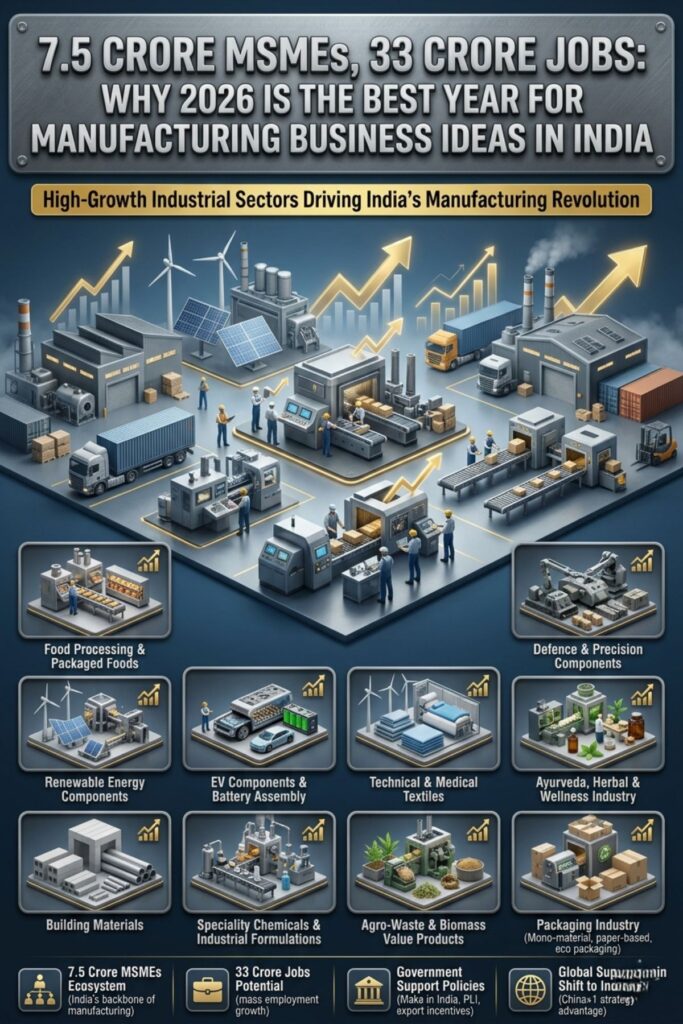
The most important decision a manufacturing entrepreneur makes is the choice of the right sector. The following table provides 10 demand-driven sectors to consider entering with their average investment amounts and key demand drivers.
| Sector | Demand Driver | Entry Investment (₹) |
| Food Processing & Packaged Foods | Urbanisation, exports, PMKSY support | 50 lakh – 5 crore |
| Defence & Precision Components | Record budget, indigenisation lists | 1.5 – 5 crore |
| Renewable Energy Components | Solar/wind capacity targets | 2 – 25 crore |
| EV Components & Battery Assembly | Electrification of 2W/3W fleets | 2 – 15 crore |
| Technical & Medical Textiles | Import substitution, export demand | 2 – 10 crore |
| Ayurveda, Herbal & Wellness | Global wellness wave, AYUSH push | 75 lakh – 4 crore |
| Building Materials (AAC, Pavers, Pipes) | Housing & infrastructure capex | 1 – 8 crore |
| Speciality Chemicals | China+1, pharma & agro chains | 5 – 20 crore |
| Agro-Waste & Biomass Products | Sustainability mandates, BHAVYA scheme | 50 lakh – 5 crore |
| Packaging (Mono-Material, Paper-Based) | Plastic substitution regulations | 1 – 6 crore |
All of these sectors have a mix of factors that make them attractive to government, structural demand and an entry price point that is not difficult. For instance, the Ministry of Food Processing Industries (MoFPI) has allocated ₹10,900 crore for the PM Kisan Sampada Yojana, which includes direct investments in cold chains, processing units, and packaging facilities. Likewise, the AYUSH sector saw its growth rate of 17% CAGR from 2014-2023 and is expected to touch ₹1.5 lakh crore by 2025, as per the Ministry of AYUSH.
Get Detailed Insights from This Book: Modern Technology of Pulp, Paper and Paper Conversion Industries
The First 180 Days: From Business Idea to Commissioning
A major obstacle to many new manufacturing facilities is not the idea — it is the lack of a sequence of actionable steps for the launch. The next 180-day plan is structured into five stages.
Phase 1: Shortlist (Days 1–30)
Narrow your list down to 3 to 5 candidates that correspond to your capital band, professional background and home-state benefits. Take into account raw materials, existing industrial clusters and state incentives. There are no funds transferred in this stage, only thoughts are being transferred.
Phase 2: Validate (Days 31–60)
Get a Detailed Project Report (DPR) if you have a candidate that you feel is your best option. A thorough DPR uses hard numbers to test market size, plant economics, and reasonable margins versus emotion and money. This is the one most crucial step.
Phase 3: Formalise (Days 61–90)
Fill out Udyam Registration Form on the government portal, register the company, look for land / Sheds and preferably consider plug and play industrial complexes for startups, and apply for Government incentives.
Phase 4: Finance (Days 91–135)
Apply for the loan with DPR under the appropriate scheme stack (PMEGP / CGTMSE / Stand up India, whichever is applicable). Apply for two loans at once to give you a better chance of getting a more competitive offer, and to shorten the processing time.
Phase 5: Build (Days 136–180)
Complete machinery suppliers with performance guarantees, hire a nucleus team of 3-5 people, and start registrations for the marketplace or buyers in advance to prepare for demand creation work ahead of the plant production. This overlap is key to bringing down the time-to-first-revenue.
Financial Snapshot: What a ₹1.5 Crore Manufacturing Project Looks Like
Too many new business owners are fooled by what they perceive as difficult obstacles to starting a business. The table below shows illustrative economics for a light manufacturing unit at a size of ₹1.5 crore, which is a feasible size for hundreds of potential products in a variety of sectors.
Identify high-growth industries before others do
| Parameter | Indicative Value |
| Plant & Machinery | ₹85 lakh |
| Building / Shed (Leased) & Utilities | ₹25 lakh |
| Working Capital Margin | ₹30 lakh |
| Preliminary & Pre-Operative Expenses | ₹10 lakh |
| Total Project Cost | ₹1.5 crore |
| Promoter Contribution (10–25%) | ₹15 – 37 lakh |
| Employment Generated | 15 – 25 persons |
| Typical Year-3 Revenue | ₹3 – 5 crore |
| Payback Period | 3.5 – 5 years |
Note: These are combined figures by light manufacturing activity. Real costs may be different from product to product and place to place. The best basis for any investment decision is a product specific DPR.
How NPCS Can Help You Choose the Right Business Idea
The primary decision that the entrepreneur has to make is a choice of the right project. NIIR Project Consultancy Services (NPCS) have been specializing in this area for more than 45 years. NPCS has a database of more than 8,000 Detailed Project Reports across more than 50 industries and has active clients in over 50 countries and the project identification, market research, techno-economic feasibility analysis and bankable DPRs meet the norms appraised by banks and PMEGP and CGTMSE.
In addition, NPCS reports are always accepted by public banks, non-banking financial corporations and state financial corporations as the basis for loan appraisal, giving the benefit to beginner’s borrowers who need both credibility as well as capital.
Start your shortlist from www.niir.org or go for sector insights and trends at www.entrepreneurindia.co.
Frequently Asked Questions
Q1. I don’t have any manufacturing experience. Is it a fatal disadvantage?
No. One experienced production supervisor at a time, first unit should be with proven technology, only made decisions based on a thorough DPR. Thousands of first-time entrepreneurs do this every year. The importance of background is very low compared to preparation.
Q2. What is the lowest amount of capital that is feasible for me to begin?
The threshold value for micro manufacturing starts from ₹25–50 lakh in various industries. Such projects can actually get started with a promoter’s initial investment of ₹5–10 lakh, with PMEGP subsidy and loan guarantees by the CGTMSE. The details of the eligible activities and maximum project cost per category are available on the PMEGP portal at KVIC.
Q3. So, should I invest in my own property or rent a shed for manufacturing?
Rent first, don’t buy first. Plug and play sheds in industrial parks save time to production and tie up your capital in machinery, which makes money, instead of in land, which sits idly. First time investments in MSMEs can benefit with subsidised shed rentals provided by many state industrial development corporations.
Q4. What are a bank’s criteria for a first-time manufacturing borrower?
The lenders have three key points to review: Realism and internal consistency of the DPR, Margin contribution by promoter and CIBIL history, Eligible scheme like CGTMSE and Stand-Up India. Sector delinquencies are at their lowest level in five years, and banks are clearly more willing to consider well-structured applications than in the last 10 years.
Q5. What is the one thing that makes the demise of the majority of new manufacturing companies?
Undersized working capital. In the case of plants, it is almost impossible not to have machines. Failure is due to cash shortages before the order book comes due. Always make your working capital assumptions conservative – that is, slow Year-1 receivables and long client payment cycles.
Q6. Is there a government scheme that is specifically for first time manufacturers?
Yes — several. PMEGP offers subsidies ranging from 15% to 35% on the project cost. Stand-Up India is a scheme that aims to provide loans to SC/ST and women entrepreneurs up to ₹1 crore. In addition, the Startup India portal also provides details on the central and state level incentives available for manufacturing startups such as tax holidays, patent support etc.
Conclusion: The Window Is Open — But Not Indefinitely
It is not a foregone conclusion that India will have an opportunity to manufacture in 2026, but it is a real opportunity. A period of exceptional circumstances – the credit market, the government and the demand of the global supply chains – will not remain forever. The China+1 window will tighten as other economies accelerate and interest rate cycles will change and policy priorities shift.
But for the business owner who chooses a product that has a demand, understands the economics with a sound DPR, and follows the credit system available, the chances of a successful manufacturing enterprise have never been greater. There were 7.5 crore MSMEs operating even before any such ideal time. They built one.
India is identifying and launching business ideas for the next 10 years that will change the face of Indian manufacturing. The only thing that matters is whether you’re in one of the founding subgroups that’s moving, or one of the many subgroups that’s waiting.


