





AI for Small Manufacturing Business in India
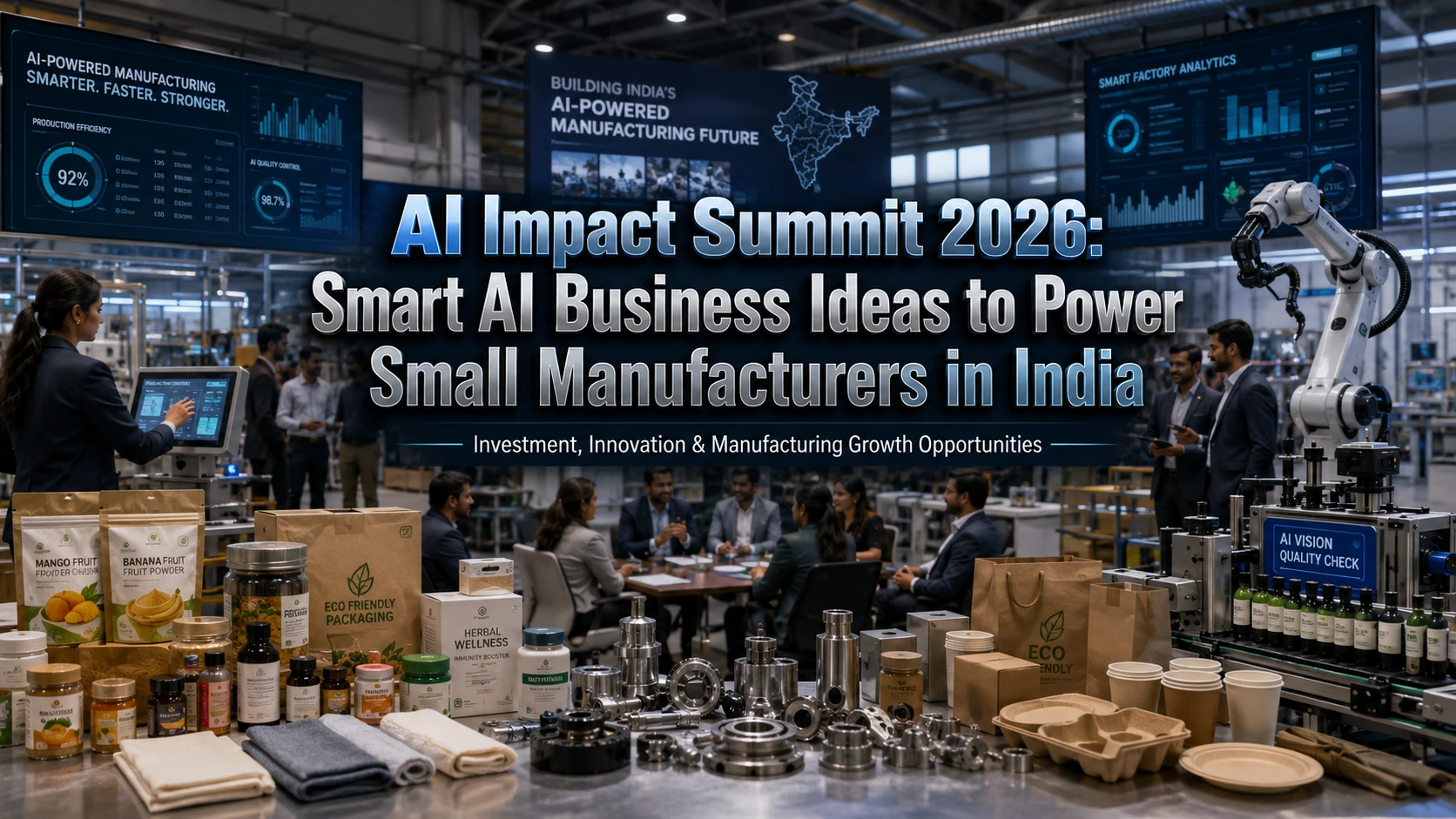
AI is now present in India’s industrial policy. Before India hosts the AI Impact Summit in 2026, this is another turnaround of the government’s view on AI in industry. The Minister of MSME has also called out the industry to adopt digitalization and AI to remain competitive globally. If you are a factory owner who long believed that AI was only an option for big businesses, it’s time to rethink, as times have changed. Whether you’re looking for a pragmatic business idea like automating your quotations or a budget-friendly quality inspection equipment, AI solutions are now available for even a 25-person manufacturing unit.
MSME Ministry data shows that there are more than 6.3 crore MSMEs registered in the country and more than 67% of them are already digitally active — doing online transactions on B2B marketplaces, making online payments, handling leads online, etc. The next step — going from digital-ready to AI-enabled — will create the competitive advantage of the next ten years. Those small manufacturers who act first will offer faster quotations, turn less, and sell more than those who wait.
Why Small Manufacturers Can No Longer Ignore AI
Most factory owners see AI as a space that requires data scientists, costly servers, and custom software – something that is too big for a mid-sized factory. That is a misconception today. The IndiaAI Mission, with its seven strategic pillars, is deliberately aimed at taking AI infrastructure and investments beyond big businesses. The four initiatives under its umbrella have been built around the issue of affordability and have been aimed at keeping the MSMEs out of the loop until now, namely IndiaAI Compute Capacity, an Application Development Initiative, Startup Financing and a FutureSkills programme.
In the meantime, there are AI tools available off the shelf that are now being offered at mobile subscription prices. The tools perform functions that previously required the services of an expert such as writing export emails in foreign languages, forecasting machine failures from vibration information, checking the quality of products with a camera and responding to questions from buyers at night. The technology gap has closed. So, it’s no longer a question of ‘Can we afford AI?’, but rather ‘Can we afford to wait?’.
Related Article: How AI Is Transforming Indian Manufacturing: 10 Practical Use Cases Every MSME and Startup Founder Should Know
Seven Practical AI Business Ideas for Small Factories
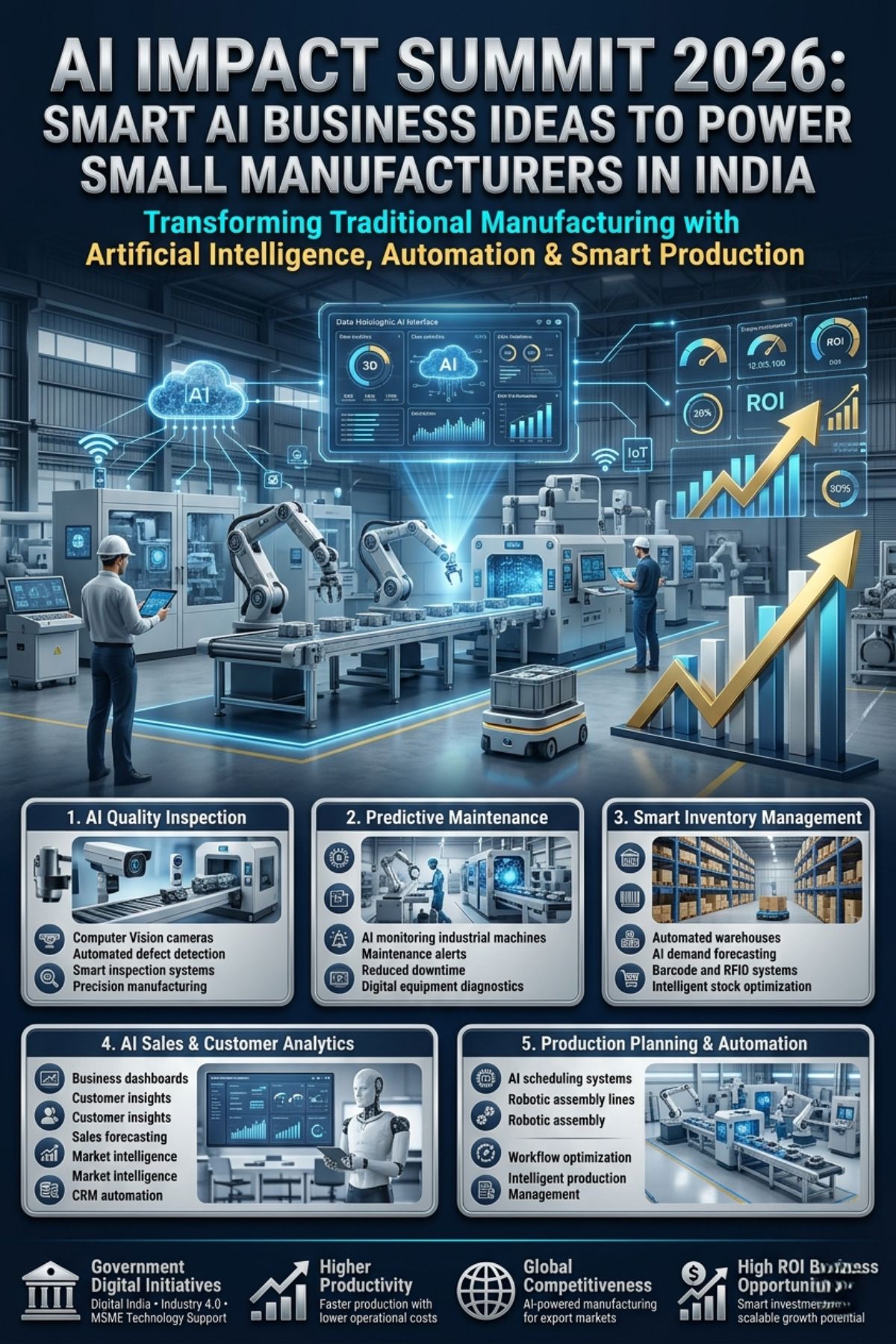
The following use cases are proven, affordable, and deployable without a single in-house data scientist. Each addresses a specific operational pain point that most small manufacturers already recognise.
| Use Case | What AI Does | Typical Monthly Cost |
| Quotation & Estimation | Reads buyer RFQs and drafts costed quotes within minutes | Rs. 2,000 – 8,000 |
| Visual Quality Inspection | Camera-based AI flags surface defects faster than manual checks | Rs. 15,000 – 50,000 |
| Predictive Maintenance | Sensors predict bearing/motor failure before breakdown occurs | Rs. 10,000 – 40,000 |
| Inventory & Demand Planning | Forecasts raw material needs from historical order patterns | Rs. 3,000 – 12,000 |
| Multilingual Sales & Support | AI chat handles buyer queries in English, Hindi, and regional languages | Rs. 1,500 – 6,000 |
| Export Documentation | Drafts proforma invoices, packing lists, and HS-code suggestions | Rs. 2,000 – 5,000 |
| Energy Optimisation | Identifies idle-running machines and peak-load waste | Rs. 5,000 – 20,000 |
Note: Costs are indicative subscription/operating ranges for small units. Vision and sensor systems involve a one-time hardware investment of approximately Rs. 1–8 lakh, depending on scale.
Get Detailed Insights from This Book: Our Books
Where to Start: Quotation Speed Wins Orders First
AI-assisted quotation is the quickest ROI that has been seen for the majority of units. Quickly responding to RFQs (within days, not hours) results in more contracts. The CII study reveals that delayed response by Indian MSMEs for export enquiries is among the leading factors for losing business to the competitors from Vietnam and China. In this regard, AI quoting tools can help you overcome this challenge at Rs. per month. 2,000–8,000.
Visual Inspection: Cutting Rejection Rates Before They Hit the Bottom Line
Rejection of quality is an unspoken cost of profit. An AI inspection system that uses a camera on just a single production line can identify surface defects, dimensional deviations, and colour inconsistencies more quickly and accurately than manual inspection methods. The QCI states that rejection rates of MSMEs more than 3% can easily eat up the operating margin of most of the units. The cost of AI inspection systems is Rs. 15,000–50,000 per month address this at the source.
The 90-Day AI Adoption Roadmap
The journey of successful AI adoption is a step-by-step process. This is a practical roadmap for any small manufacturer to follow – non-destructive to production.
- Days 1-15: Diagnose: Identify your three highest costing recurring issues you have — rejected lots, delayed quotations, machine down time, not answering enquiries. When implementing AI begins with the technology rather than a tangible business challenge, it can fall short.
- D16-30 Select: Select one use case where there was a measurable money impact. The speed of quotation or quality inspection for most units is the quickest option.
- Days 31-60: Pilot – Conduct a paid pilot using an off the shelf tool for one product line/machine. Monitor before and after numbers: rejection percentage, quote turnaround time, downtime hours.
- Skill Up: Train 2 to 3 of your existing staff (not new staff) on the tool for days 61–75. This training is subsidised by programmes under the IndiaAI Future Skills and MSME Ministry digital initiatives.
- Days 76 – 90: Scale – run the working solution on a different set of lines and find the second use case. Record your savings and they will help make your next bank loan proposal stronger.
The key takeaway: Technology adoption often fails because it begins with the technology and not with a specific and measurable problem. It’s all about the problem, not the platform; that’s the difference between a successful pilot and a costly experiment.
Find high-return business ideas based on your budget & ROI
Government Support You Can Tap Today
The IndiaAI Mission and the Ministry of MSME have laid out a number of programmes to directly impact the cost and risk of adopting AI for small manufacturing units. These schemes are in place and largely underutilised.
- IndiaAI Startup Financing: Support in funding for AI-driven startups under the financing pillar of IndiaAI Mission for both startups and existing MSMEs entering AI.
- FutureSkills Programme: AI skilling in government subsidies for the owners & workers under IndiaAI FutureSkills. It is also well provided for the training cost which is also a big hurdle in the adoption.
- MSME TEAM Scheme: The government has also stated that ONDC, which features AI cataloguing and pricing tools will bring onboard 5 lakh micro & small enterprises to the platform thereby providing an instant online selling platform with AI.
- The Capital Subsidy Route can include the cost of AI-powered machinery, such as vision inspection systems, and IoT-integrated equipment, as part of regular plant modernisation subsidies.
- State-Level Programmes: States such as Haryana have introduced dedicated programmes for promoting the adoption of AI for MSMEs to boost productivity and competitiveness. Others states are following suit.
Moreover, the Ministry of Electronics and Information Technology (MeitY) operates parallel digital infrastructure support schemes, which are often not recognized by the MSME owners. Reaching your closest District Industries Centre is often the quickest method to determining applicable support.
Access Complete Business Plan: Project Reports & Profiles
Financial Snapshot: AI Retrofit for a Mid-Size Unit
The numbers below are indicative for a typical mid-sized manufacturing unit running 5–15 machines across one or two product lines. Units with higher baseline rejection rates will see payback faster.
| Parameter | Indicative Value |
| Vision inspection system (1 line) | Rs. 4.5 lakh (one-time hardware) |
| IoT sensors + predictive maintenance (5 machines) | Rs. 2.5 lakh (one-time hardware) |
| Software subscriptions (quoting, chat, planning) | Rs. 15,000 per month |
| Staff training (largely subsidised) | Rs. 50,000 |
| Total first-year outlay | Rs. 9 – 10 lakh |
| Typical annual savings (rejections + downtime + speed) | Rs. 12 – 20 lakh |
| Payback period | 8 – 14 months |
Note: Savings depend on baseline rejection and downtime levels. Units with rejection rates above 3% typically see the fastest payback, often within 8–10 months.
These figures show that AI adoption at the MSME level is not a capital-intensive gamble. Furthermore, with government subsidies covering training and partial hardware costs, the effective out-of-pocket spend is considerably lower than the headline figures suggest.
From Digital-Ready to AI-Enabled: What Changes
Unfortunately, a lot of factory owners don’t realize how much things change when AI does a task. This change is not only for cost reduction. It has the effect of altering the speed of the business.
- Quoting speed is 2-3 days to 2-3 hours, winning rates are immediately enhanced when bidding on competitive tenders.
- AI inspection reduces quality rejections, as it helps identify errors that might be overlooked by human inspectors due to fatigue or inadequate lighting conditions.
- Machine breakdowns are decreased by 3 to 7 days as predictive maintenance provides a warning ahead of time when machine breakdowns would normally occur.
- Automatic generation of export documentation — all the paperwork that prevents small units from exploring international buyers.
- Buyer enquiries are responded to at any time of the day, in a variety of languages, without the addition of any employee.
Together, all these changes add up. A unit that quotes faster, rejects less, runs machines longer, responds to buyers at midnight is structurally more competitive than one that quoted slower, rejected more, did not run machines for long or did not respond to buyers at midnight. The Confederation of Indian Industry (CII) in its recent report on MSME competitiveness, mentioned that the productivity difference between small manufacturers that use AI and those that do not is increasing year by year.
How NPCS Can Help You Plan the Right Project
NIIR Project Consultancy Services (NPCS) offers help to entrepreneurs in setting up modern and technology equipped manufacturing units from a scratch. Economics of a new plant more and more include automation, Industry 4.0 readiness and digital sales channels — an 8,000+ Detailed Project Report is designed with these factors in mind, and not added on later.
The techno-economic feasibility study and market viability research that can be obtained at www.niir.org and www.entrepreneurindia.co lay the foundation for an investable project, whether you are looking at a new business venture or updating an existing business line.
Frequently Asked Questions
Q1. Can AI be used in a small team of less than 20 employees?
Yes — it seems more so. AI is most effective when managed by small teams, freeing up the owner’s time for production and sales. But it’s not about implementing AI all at once: It’s about getting one AI solution into one costly operation.
Q2. Is it required to have my own data or servers?
No. Subscription tools are 100% cloud based. The IndiaAI Compute pillar is also enabling subsidised access to computing resources for startups that can develop custom solutions. The software can be run on most laptops or tablets.
Q3. If my staff does not embrace the change, what will happen?
Don’t start with tools that are viewed as monitoring tools, but with tools that eliminate drudgery: paperwork, repeated buyer queries, manual data entry. Train current employees first. After one problem on the surface clears up, the adoption process moves swiftly. Workers will embrace AI when it makes their role easier, not more difficult.
Q4. Which use case yields a quickest payback?
AI-powered quote generation can generate more orders in the blink of an eye for most manufacturers, with quotes being responded to within hours rather than days. Following this, visual quality inspection should be carried out, especially for those units with rejection rate higher than 3%. These two case studies, combined, produce the savings needed to cover the entire AI adoption journey.
Q5. Are there potential risks of selecting the wrong tool?
Pilot before committing. Operate for 30-60 days one line, with clear measurable objectives. The price of a botched pilot is a few thousand rupees. This is more expensive because another firm provides a faster service, and are less selective about which jobs they turn down.
Q6. How does AI fit in with government loan and subsidy applications?
It is expected that the related equipment such as vision inspection systems, IoT sensors for AI will be treated as productive capital goods and covered under the scheme for technology upgradation. Also, measuring the savings you incurred due to the use of AI can provide a strong argument while applying for your working capital loan or an extension loan. Contact your District Industries Centre (DIC) for guidance in determining schemes that are relevant in your state.
Conclusion: The Window Is Open — But Not Forever
AI Impact Summit 2026 is the turning point of Indian manufacturing. Infrastructure supports government, funds are available, and off-the-shelf tools are affordable. The advantage for today goes to the early movers: factory owners who recognize one problem that is costly, conduct a targeted pilot and scale what works.
By being strategically ahead of the curve with AI-inspired business models, small manufacturers will be in a greater position within a year. If you’re waiting for the technology to become mainstream, you’ll discover that your competitors have already taken an unassailable position in terms of speed, quality and cost effectiveness. The above roadmap of 90 days is a feasible starting point. The tools exist. Help is on hand. The only question now is, when do you want to start this quarter or the next?


